
UK guide
Starting a mobile barber business
How to start a mobile barber business in the UK
A mobile barber does not pay shop rent or a chair fee, and the kit fits in a car boot. The hard part is time. A 45-minute haircut can use 80 minutes once you carry the kit in, clean up and drive to the next customer. This guide takes the UK steps in order: registering, insurance, kit, your area, prices, bookings and your first customers.
Quick answer
To start a mobile barber business in the UK, register with HMRC as self-employed, ask your council whether it registers barbers, and buy insurance that covers home visits and business driving. Then pack a kit you can carry, choose a small service area, price each visit with the travel time included, and take bookings by address so the drive between customers is always allowed for.
Is a mobile barber business right for you?
It suits a trained barber who wants to set their own hours and is happy working alone. Your customers are people who would rather not travel to a shop: older customers, parents with young children, people who work shifts, people who find it hard to get out, care home residents and staff at workplaces. Many of them want the same cut every few weeks, which is what makes a diary steady.
Be honest about the downsides. You will fit fewer cuts into a day than you would at a chair, because every cut comes with a drive. You carry the kit up stairs, work in kitchens with poor light, and sweep up before you leave. There are no walk-ins to fill a quiet afternoon. Parking, traffic and a customer who is not home are your problem. If you like the noise of a busy shop, the quiet can be hard.
You also need to choose between visiting homes and cutting inside a fitted van. Home visits are the lower-cost way to start, and you find out quickly whether your area has enough demand. You can add a van later, once the numbers support it.
| Question | Home visits | Fitted barber van |
|---|---|---|
| Where you cut | In the customer's kitchen or living room, with their chair, light and sockets. | In your own space, set up the same way every time. |
| What you pay for | A portable kit, a car you may already own, and cleaning supplies. | The van, the conversion, power and water on board, upkeep and somewhere to park it. |
| Checks to make | Council registration where it applies, and insurance for work in homes. | The same, plus parking rules and a street trading licence if you trade from the road. |
| Main risk | Time lost carrying, setting up and clearing up at each address. | A breakdown or repair stops the whole business until the van is back. |
Register with HMRC and check your council's rules
The simplest way to start is as a sole trader. GOV.UK says you can start trading straight away, but you must register for Self Assessment once you earn more than £1,000 from self-employment in a tax year (6 April to 5 April). You must tell HMRC by 5 October after the end of that tax year, and registering late can mean a penalty. A limited company is the other common choice. It limits your personal liability, but it brings company accounts and filings, so speak to an accountant before you pick it.
Keep a record of every sale and every cost from day one. You pay Income Tax and National Insurance on your profit. The online return and the payment are both due by 31 January after the tax year ends. You must register for VAT if your taxable turnover goes over £90,000. From 6 April 2026, sole traders with qualifying income over £50,000 have to use Making Tax Digital for Income Tax. HMRC says the threshold falls to £30,000 in April 2027 and £20,000 in April 2028, so it is worth keeping digital records from the start.
There is no compulsory national licence for barbers in the UK. The Hair and Barber Council keeps the register set up by an Act of Parliament in 1964, and it says registration is currently voluntary. Joining is a way to show customers you are trained. Separately, GOV.UK tells barbers in England to ask their local council whether it requires registration. A council that does may charge a fee and inspect before it gives you a certificate. Describe how you really work (home visits, or a van) when you ask. In Scotland, Wales and Northern Ireland, ask the council for each area you plan to cover.
Two more checks. If you will cut from a van parked on the street, ask the council about a street trading licence. GOV.UK says you may need one to trade in the street in England and Wales, and trading without one can bring a fine of up to £1,000. And if you keep customers' names, addresses and phone numbers, read the ICO's page on the data protection fee to see whether you need to pay it.
Insurance and safety for home visits
Business.gov.uk lists two kinds of insurance the law requires: employers' liability if people work for you, and motor insurance if you use a vehicle in your business. Tell your motor insurer that you drive to customers for work and carry tools. Ask them to confirm in writing that business use is covered. A standard personal policy may not cover it, and only your insurer can tell you.
Public liability insurance covers claims for injury or damage to property, such as a customer tripping over your case or a spill on a carpet. Ask the insurer whether the policy also covers the work itself, such as a nick from a blade or a skin reaction, and whether shaving with an open razor is included. Ask about tools left in the car too. Care homes and workplaces may ask to see your certificate before they let you in.
If you take someone on later, GOV.UK says you need employers' liability cover of at least £5 million from the day they start, and you can be fined £2,500 for every day you are not properly insured.
On safety, HSE says frequent contact with water and shampoo can cause dermatitis. Its advice for hair work is simple: wear disposable non-latex gloves for wet work and change them between clients, dry your hands fully, moisturise often and check your skin. Clean and disinfect clippers, combs and scissors between customers in the way your training and the product label say, and carry a container for used blades. HSE also says the law requires electrical equipment used for work to be kept safe, but it does not demand a yearly test. Check leads and plugs before each day and replace anything damaged.
Mobile barber kit and vehicle: a starter list
Buy for the services you will sell in month one, not for every cut you might offer one day. Lay the whole kit out, pack it, carry it up a flight of stairs and time a full set-up and clear-up at home before you take a booking. If it takes three trips to the car, it is too much.
- Clippers and trimmers with guards, plus a spare or a charged second battery.
- Scissors, combs, a razor with single-use blades and a container for used blades.
- Capes, neck strips and enough clean towels for a full day, with a separate bag for used ones.
- Disinfectant made for barber tools, surface wipes and hand gel.
- A portable mirror, a clip-on light and a folding stool for homes without a suitable chair.
- A floor sheet, a dustpan and brush or small vacuum, and bags to take hair away.
- An extension lead and a way to charge clippers in the car.
- A card reader or payment link, a phone mount and a charger.
- Cases that keep clean kit apart from used kit.
What the car costs you
For home visits, any reliable car will do. What matters is that you count what it costs. Fuel, insurance, servicing, tyres and parking are all business costs for the miles you drive to customers. HMRC lets sole traders claim a flat rate per business mile instead of working out the actual costs. Its page lists 55p a mile for the first 10,000 business miles in the 2026 to 2027 tax year and 25p after that. Check the current rate before you claim, and log every trip with the date, the miles and the reason.
There is no single start-up figure worth quoting, because a barber with a car and a set of clippers starts from a different place than one fitting out a van. Write three lists instead: one-off purchases, monthly bills, and a cash reserve for a quiet month or a repair. Get real quotes for each line. If you are pricing a van conversion, ask the converter what is included, how long the van is off the road for repairs, and where you will park it overnight.
Set your service area and travel rules
Start small. Pick a few neighbourhoods that join up and drive between them at the times you plan to work. A short trip across a river or past a school at 3pm can take longer than a longer trip on a clear road. Look at parking as well as the map: permit zones, pay and display, and flats where the walk from the car takes five minutes each way.
Then write your travel rules down before the first booking. How far will you go? Is travel included inside a set distance? What do you charge beyond it? Is there a minimum spend at the edge of your area, such as two cuts at one address? Will you cover one side of town on set days so the drives stay short? Customers accept clear rules. What they dislike is a surprise fee on the doorstep.
Put numbers on it before you publish. The service area calculator shows what an outer postcode leaves you after the drive, and the service area guide explains how to review the boundary each month.
Price a mobile haircut: a worked example
Price the whole visit, not the minutes with clippers in your hand. Keep the list short to begin with: a haircut, a skin fade, a haircut with beard trim, a child's cut, and a price for a second person at the same address. Say what each one includes and how long it takes.
Here is an example with made-up numbers. Replace them with your own. Allow 45 minutes for the cut, 10 for setting up and cleaning, 20 for the drive and 5 for parking and getting in. That is 80 minutes. At £40, with £7 of supplies and vehicle costs, you keep £33. Over 80 minutes that is £24.75 an hour before insurance, tax, phone, days off and time spent answering messages.
Now move the same cut to the edge of your area, 15 minutes further away. The £33 is spread over 95 minutes, which is about £20.84 an hour. A £5 travel charge brings it back to £24 an hour. That is the choice you are making with every boundary: charge for the distance, shrink the area, or accept a lower hourly figure for that customer.
Shop prices near you are a useful reference, but a home visit is a different service and you can price it differently. Do not count on tips to make a low price work. After 20 visits, compare the time you planned with the time each visit really took, and change the prices or the durations that were wrong.
Take bookings without double-booking yourself
For a mobile barber, a double-booking is rarely two people in the same slot. It is two addresses that are too far apart. A paper diary, or a booking app made for shops, will let someone book 2:45pm across town straight after a 2pm cut, because it has no idea where either customer lives. The fix is the same whatever you use: get the address before you offer a time, and block the drive on both sides of every visit.
You can do this by hand at the start. Keep one diary, add a fixed gap after each cut, and check the map before you say yes. It works for a handful of bookings a week. It gets harder when messages arrive while you are mid-fade and three people want Saturday morning.
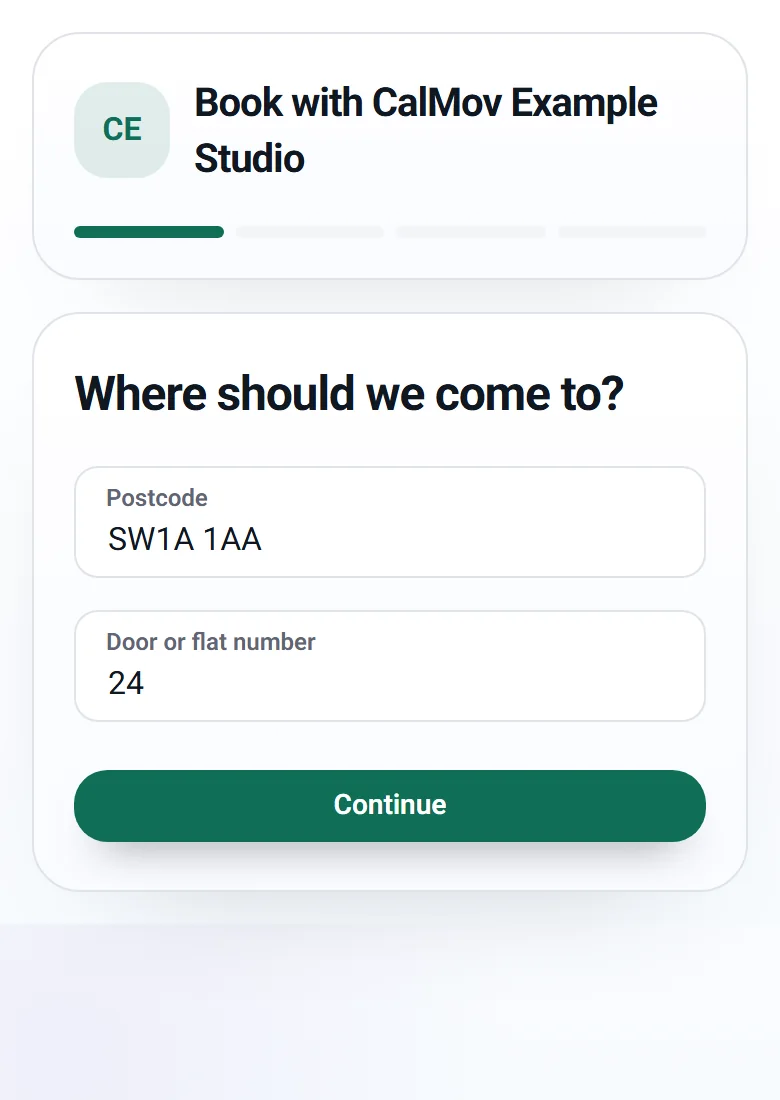
CalMov is online booking built for businesses that travel to customers. The customer enters their address first, and CalMov only offers times you can reach, allowing for the journey before and after each visit. Lite is free, with up to two active services and a fixed travel gap that you set. Pro uses road-based drive times with expected traffic and can add travel charges by distance or drive time. It runs in the phone's browser, so there is nothing to install.
A few parts are set up for barbers. Cut notes let you tap Start job on the day, see a timer against your estimate and keep notes on the cut, so the next visit starts where the last one ended. Rebooking reminders are filled in at three weeks for barbers: about a week before a customer is due, CalMov emails them a link that opens your booking page on the same service around their due date. On Pro, group bookings with a discount cover a dad and two kids at one address, and returning customers can reuse their saved details instead of typing them again.
Find your first 20 customers
Twenty regulars on a three-week cycle is about seven cuts a week before anyone new finds you. That is a base you can build on, and most of it comes from people within a couple of miles. Work through this list in order.
- Tell people who already know your cuts: friends, family and past customers. If you are leaving a shop, read your contract first for any terms about taking customers with you.
- Set up a Google Business Profile as a business that visits customers, list the areas you cover and add your booking link. Ask every happy customer for a review.
- Post in local Facebook and WhatsApp groups where the rules allow it. Say where you cover, show a cut (with the customer's permission) and give the booking link.
- Phone care homes, sheltered housing and supported living services. Ask who arranges haircuts, what checks and insurance they need to see, and offer a regular morning.
- Ask depots, offices, gyms and sports clubs whether you can cut on site one afternoon a month.
- Leave cards with your booking link in places your customers already go, such as cafes, barbers' suppliers and community centres.
- Before you leave each house, offer the next date. A customer who books again on the doorstep does not need winning twice.
- Give each customer two cards to pass on. A neighbour two doors down is the cheapest drive you will ever make.
Your first month: a week-by-week checklist
Do the paperwork before the first paid cut, then open slowly. A light first month teaches you more than a full one, because you have time to write down what really happened.
- Week 1: ask your council about registration, get insurance quotes for home visits and business driving, and start a simple record of sales and costs.
- Week 1: write your service list, prices, area and travel rules. Pack the kit and rehearse a full visit at home, including the clear-up.
- Week 2: set up your booking page and test it on a phone with a nearby address and one at the edge of your area. Book three or four people you know.
- Week 2: time every visit: arrival, start, finish and leaving. Note what you forgot to pack.
- Week 3: open bookings to the public in your core area only. Ask each customer for a review and offer the next date before you leave.
- Week 3: contact two care homes or workplaces and follow up within the week.
- Week 4: compare planned and real times, fix any service that ran over, and check what each area left you after the drive.
- Week 4: put money aside for tax from every payment, and set a date each month to review prices, area and costs.
Frequently asked questions
Do I need a licence to be a mobile barber in the UK?
There is no compulsory national licence. State registration with the Hair and Barber Council is voluntary. In England, GOV.UK says to ask your local council whether it requires barbers to register, and you may need a street trading licence if you trade from a van in the street. Elsewhere in the UK, ask the council for the area you work in.
Do I need a qualification to work as a mobile barber?
The law does not set one. The Hair and Barber Council says anyone can currently practise without training or qualifications, which is why it campaigns for compulsory registration. In practice your insurer will ask what training you have, and customers will too. Ask the insurer which qualifications it accepts before you buy a policy.
Do I need a fitted van to be a mobile barber?
No. You can visit homes with a portable kit and an ordinary car. A van gives you the same workspace every time, but it adds the conversion, upkeep, parking and possibly a street trading licence. Start with the model you can afford to run for six months.
How much does it cost to start a mobile barber business?
It depends on what you already own. A barber with a car and tools mainly needs insurance, portable extras and cleaning supplies. A van conversion is a much larger cost. Write three lists (one-off purchases, monthly bills and a cash reserve) and get real quotes for each line rather than relying on a figure from the internet.
How much should a mobile barber charge?
Enough to pay for the whole visit: the cut, setting up, clearing up and the drive. Add up the minutes for a typical visit, take off supplies and vehicle costs, and see what is left per hour. The worked example above and the mobile barber pricing calculator show the sums.
Can I start mobile barbering while I still work in a shop?
GOV.UK says you can be a sole trader and an employee at the same time. You must register for Self Assessment once your self-employed earnings pass £1,000 in a tax year. Check your contract or chair agreement first for anything that limits work outside the shop.
Do I need to tell my car insurer I am a mobile barber?
Yes, speak to them before your first paid visit. Motor insurance is a legal requirement when you use a vehicle in your business, and you need the insurer to confirm that driving to customers and carrying tools is covered.
How do I avoid long drives between bookings?
Ask for the address before you offer a time, keep to a small area, and group each side of town on set days. Booking software that checks the journey before and after each visit, such as CalMov, only shows customers the times you can reach.
Sources and further reading
Sources used to check this guide. Check the linked guidance for current requirements, features and prices.
- Become a sole trader: responsibilities and registration — GOV.UK
- Register as a sole trader: who must register and by when — GOV.UK
- Self Assessment tax returns: deadlines — GOV.UK
- How VAT works: VAT thresholds — GOV.UK
- Find out if and when you need to use Making Tax Digital for Income Tax — HM Revenue and Customs
- Hairdresser and barber registration in England — GOV.UK
- About the Hair and Barber Council and voluntary state registration — The Hair and Barber Council
- Street trading licence (England and Wales) — GOV.UK
- The data protection fee — Information Commissioner's Office
- Insuring your business — Business.gov.uk
- Employers' liability insurance — GOV.UK
- COSHH and hairdressers: working with hairdressing products — Health and Safety Executive
- Portable appliance testing: frequently asked questions — Health and Safety Executive
- Simplified expenses if you're self-employed: vehicles — GOV.UK
How CalMov helps
CalMov combines service duration, working availability and customer location to help mobile businesses offer bookable times that allow for the surrounding journeys.
See CalMov for mobile barbers