
UK guide
Starting a mobile valeting business
How to start a mobile car detailing business in the UK
A pressure washer and a van will get you a first job. They will not tell you where the dirty water goes, what happens when it rains for a week, or how a three-hour valet 25 minutes away fits before the school run. Mobile valeting and detailing is a good business to start small, as long as you sort the water, the insurance and the diary before you take money. This guide goes through the UK steps in order.
Quick answer
To start a mobile car detailing or valeting business in the UK, register with HMRC as self-employed, work out how you will stop wash water reaching surface water drains, and insure yourself for business driving and for the cars you work on. Start with two or three packages priced by vehicle size and condition, cover a small area, and take bookings by address with the water, power and parking questions asked up front.
Is mobile valeting and detailing right for you?
It suits someone who likes physical, careful work and is happy outdoors. You can start part-time at weekends, the first kit is modest, and good work is visible: a clean car on a drive is its own advert. Customers range from busy families who want a regular valet to owners who want paint corrected and protected, plus small fleets such as taxis, driving school cars and company vans.
The downsides deserve a straight answer. The weather decides more than you would like. Rain, frost, strong wind and low winter light all stop or slow exterior work, and British winters are long. The work is hard on your back, knees and hands. You carry water, chemicals and machines, so the van is heavy and needs organising. Jobs are long, so one late start pushes everything after it. And you work on something expensive that its owner cares about, so a mistake can be costly.
Decide where you sit between valeting and detailing. A valet is a thorough clean inside and out, and it is repeatable. Detailing adds machine polishing, paint correction and coatings. Those need more skill, more time and dry, controlled conditions. A sensible route is to begin with valeting and add detailing as your training and kit allow.
Register with HMRC and check where you can work
You do not need a licence to valet cars, but you do need to tell HMRC you are trading. As a sole trader you must register for Self Assessment once you earn more than £1,000 from self-employment in a tax year, and GOV.UK gives 5 October after the end of that tax year as the deadline. A limited company is the alternative. GOV.UK explains the difference: a sole trader is personally responsible for the business's debts, while a company's owners have limited liability but must file accounts.
Record every job and every receipt. Income Tax and National Insurance are charged on your profit, and the online return and payment are due by 31 January. Register for VAT if your taxable turnover goes over £90,000. From 6 April 2026, Making Tax Digital for Income Tax applies to sole traders with qualifying income over £50,000, and HMRC says the threshold falls to £30,000 in April 2027 and £20,000 in April 2028.
Next, where will you work? On a customer's own drive with their permission is the simple case. A public road, a car park or a business park is different. GOV.UK says you may need a street trading licence to trade in the street in England and Wales, so ask the council before you set up a regular pitch. On private land such as a supermarket or office car park, you need the landowner's permission. If you keep customers' names, addresses and registration numbers, check the ICO's guidance on the data protection fee.
Waste water: the rule mobile valeters miss
This is the part of the job with real legal weight. The Environment Agency's guidance for England lists vehicle washing as an activity that produces contaminated water, which it calls trade effluent. It says surface water drains discharge directly to the environment, and that contaminated water must go to the foul drain, be recycled or be taken away. Road gullies and driveway drains often lead to surface water drains, so never assume a drain is safe to use. The guidance also says that if you pollute you could get an unlimited fine, up to five years in prison, or both, and may have to pay for the clean-up.
The foul sewer is not a free alternative. The same guidance says you need your water company's permission to put trade effluent into the foul or combined drain. Thames Water, for example, defines trade effluent as any liquid waste discharged to its sewers from a business or trade process, lists commercial car washes among the businesses that normally need consent, and says discharging without consent is an offence. Contact the water company for the area you work in and describe exactly what you do.
In practice mobile valeters use a mix of methods: low-water or rinseless washing, a wash mat that collects run-off, a wet vacuum to recover water, and taking the water away to dispose of at a place that is allowed to take it. Whichever you choose, write it down and be able to explain it to a customer or a council officer. A shampoo that says biodegradable on the label does not make run-off acceptable; the Environment Agency points out that detergent stops oil separators working.
If you carry dirty water and other waste away from jobs, GOV.UK's business waste rules apply. You must store waste safely and use proper disposal, and you must register as a waste carrier if you transport waste. In England registration is usually free if you only carry waste your own business produced. Scotland, Wales and Northern Ireland have their own regulators and water companies, so check with SEPA, Natural Resources Wales or the Northern Ireland Environment Agency if you work there.
Insurance and chemical safety
Business.gov.uk lists motor insurance as a legal requirement when you use a vehicle in your business. Tell your insurer the van carries a water tank, machines and chemicals and is used to visit customers. Ask them to confirm the cover in writing.
Public liability covers injury or damage to property, such as a passer-by tripping over a hose. Ask very directly whether the policy covers damage to the car you are working on, because that is the obvious risk in this work. Do not assume a standard policy includes it. If you ever move or drive a customer's car, ask about that too. Add cover for your equipment, in the van and at home. If you take on a helper, GOV.UK says employers' liability insurance of at least £5 million is required as soon as you become an employer, with fines of £2,500 a day without it.
Chemicals come under COSHH, the regulations on substances hazardous to health, and HSE publishes guidance for the self-employed as well as employers. Its page on cleaning substances and valeting says many of them can harm you through skin contact, splashes in the eye or breathing in mist and vapour. Its advice: compare safety data sheets and pick the least harmful product, keep all doors open when you work inside a vehicle, and wear suitable gloves and eye protection. Keep the safety data sheet for every product in the van, store chemicals upright in a secured box, and never decant them into drinks bottles.
Water and electricity do not mix. HSE says the law requires electrical equipment used for work to be kept in a safe condition. Check leads, plugs and hoses before every job, keep connections off wet ground and replace damaged cables rather than taping them.
Kit and van: a starter list for valeting
Buy for the two or three packages you will sell first. Polishers and coatings can wait until you are trained and have customers asking for them.
Water is heavy: one litre weighs one kilogram, so a 250-litre tank adds a quarter of a tonne before you load anything else. Check the payload on the van's weight plate before you fit a tank, and have tanks and racking secured properly. A small van or an estate car with a low-water set-up can be enough to begin with.
HMRC lets sole traders claim a flat rate for business miles instead of actual vehicle costs. Its page shows 55p a mile for the first 10,000 miles in the 2026 to 2027 tax year and 25p after that. Check the current figure and keep a mileage log. For your start-up budget, list one-off purchases, monthly costs (insurance, chemicals, fuel, phone, software) and a reserve for bad-weather weeks, and price each line with real quotes.
- A vacuum, plus a wet vacuum or extractor for seats, carpets and recovering water.
- A pressure washer or a low-water wash system, hoses and a water tank if you carry your own supply.
- A wash mat or another way to contain run-off, and containers to carry dirty water away.
- A generator or battery power if you will not rely on customers' sockets, and an outdoor extension lead.
- Buckets with grit guards, wash mitts, brushes for wheels and interiors, and plenty of microfibre cloths.
- Shampoo, wheel cleaner, glass cleaner, interior cleaner and a protection product, each with its safety data sheet.
- Gloves, eye protection, waterproofs and knee pads.
- Steamer, machine polisher and pads once you offer the services that need them.
- A phone for before and after photos, a card reader or payment link, and a gazebo or cover for light rain if you choose to work in it.
Set your service area and travel rules
A full valet can take two or three hours, so you may only fit two or three into a day. One long drive between them can cost you a whole job. Start with a compact area: your own town and the villages or postcodes next to it. Drive it at working hours and note where a van can park and work.
Write the rules down. How far do you go? Do you charge for travel beyond a set distance? Is there a minimum job value at the edge of the area? Will you take single small jobs far out, or only when two cars are booked at the same address? Say what you need at the address too: space around the car, permission to work there, and whether you need the customer's water and power.
Add a weather rule. Tell customers what happens if rain, frost or wind stops the job: who decides, how early you will tell them and how the booking moves. Keep a few slots a week free so moved jobs have somewhere to go.
Price a valet by size and condition: a worked example
Sell a defined result. A maintenance valet, a full valet and an interior deep clean are different jobs, so say what each includes and what it does not. Then price by vehicle size (small, medium, large, van or 4x4) and by condition, because a family car with dog hair and sand is not the same job as a commuter's hatchback.
An example with invented numbers: a full valet takes 110 minutes of cleaning, 20 minutes to set up, 20 to pack away and deal with waste water, and 30 minutes of travel. That is 180 minutes. At £120, less £24 for products, fuel and other direct costs, you keep £96, which is £32 an hour before insurance, tax, admin and days lost to weather. It is an illustration, not a suggested price.
Now the same package on a large 4x4 that takes 40 minutes longer. At the same £120, the £96 is spread over 220 minutes: about £26.18 an hour. A £25 size supplement brings it back to £33. Do the same sum for heavy soiling. If a package keeps overrunning on certain cars, the price list is wrong, not your speed.
Keep paint correction, heavy pet hair, mould and anything you cannot judge from a description as a quote after photos or a look at the car. And count the whole day: the drive from home, the drive back, refilling water and washing cloths all take time that jobs have to pay for.
Take bookings without double-booking yourself
With long jobs, one bad booking wrecks a day. The usual causes are a second job too far from the first, a car that turns out to be bigger or dirtier than described, and an address with no water, no power or nowhere to park the van. All three can be caught before you confirm: take the address first, ask about the car, and ask about the site.
You can do this by phone and a paper diary at first. Ask the same questions every time and write the answers down. It gets harder when enquiries arrive while you are mid-job with wet hands.
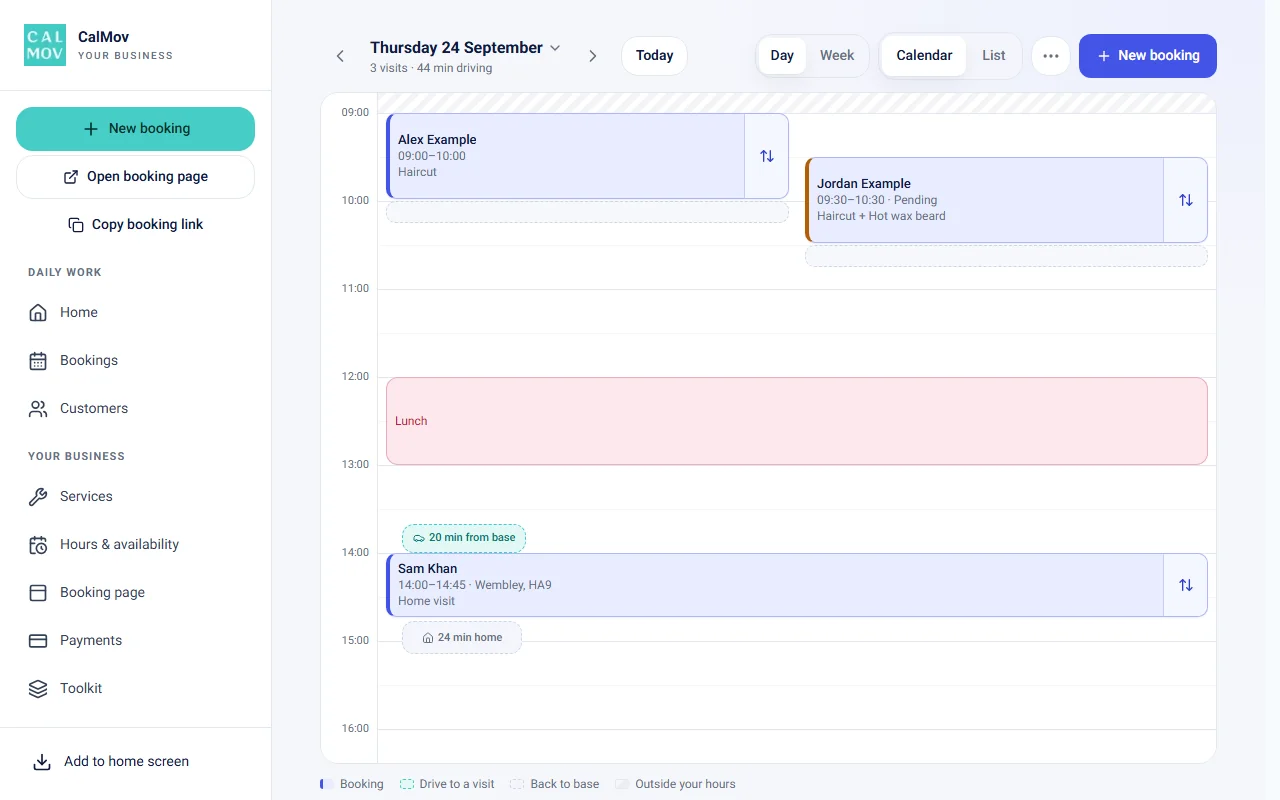
CalMov is online booking for businesses that travel to customers. The customer enters their address first, and CalMov only offers times you can reach, allowing for the journey before and after each visit. Lite is free, with a fixed travel gap that you set and up to two active services. Pro uses road-based drive times with expected traffic and can add travel charges by distance or drive time. The calendar shows the drive time between jobs and the drive back to base.
For valeters and detailers, time and price questions do the pricing work. Vehicle size and condition can be combined into one table where each pair of answers sets the time and price, and the customer sees the result as they answer. An answer such as heavy pet hair can be set to 'Can't book online', so the customer is told to get in touch, or on Pro to 'We'll review it', where they send a request, the time is held and you confirm, adjust or decline. Site and access questions ask about parking, power, water and space to work in a short form after booking, and the answers are saved to the address for next time.
On Pro, Photos lets you take before and after pictures in job mode, up to 12 a job, and email the customer a report with the ones you choose. Customers cannot upload their own photos yet, so ask for those by message when you need them for a quote. Each customer's vehicles can be saved, so a regular picks the car instead of typing it in again.
Find your first 20 customers
Twenty customers on a monthly maintenance valet is five cars a week before any one-off work. Regulars are easier to serve than one-off deep cleans, because the car is never in a bad state and the drive is one you already know.
- Start on your own street and with people you know. Offer a first valet at full price and ask for honest feedback and a review.
- Set up a Google Business Profile as a business that visits customers, with your area, packages, before and after photos (with permission) and your booking link.
- Post in local Facebook groups where the rules allow. One clear before and after picture, your area and how to book is enough.
- Visit small fleets: taxi firms, driving instructors, estate agents, care providers and trades with sign-written vans. Offer a regular day.
- Ask independent garages, body shops and small car dealers whether they need a valeter for overflow work.
- Talk to office and business park managers about an on-site day, with permission from the landowner and a plan for waste water.
- Before you leave each job, offer the next date. A monthly slot on the same day is easy for the customer to remember.
- Leave a card with every finished car, and one through the door of the neighbours either side.
Your first month: a week-by-week checklist
Sort the water plan and the insurance before the first paid job. Then keep the first weeks light and close to home, so travel does not hide problems with the service itself.
- Week 1: decide how you will contain and dispose of wash water, and speak to your water company if you plan to use the foul sewer. Check waste carrier registration.
- Week 1: get motor and liability quotes that cover the vehicles you work on. Start a record of sales, costs and mileage.
- Week 2: fix two or three packages with prices by size and condition, your area, and your weather and travel rules.
- Week 2: load the van, check the weight, and do two full practice valets on friends' cars. Time every stage, including pack-down.
- Week 3: set up your booking page with the car and site questions, test it on a phone, and open bookings in your core area.
- Week 3: photograph every job before and after, with permission, and ask each customer for a review.
- Week 4: compare quoted and real times by car size. Change any package that overran twice.
- Week 4: approach three fleets or garages, set aside tax from the month's takings, and book a monthly review of prices and area.
Frequently asked questions
Do I need a licence to start a mobile valeting business in the UK?
There is no licence for valeting itself. You need to register with HMRC once you earn over £1,000 from self-employment in a tax year. You may need a street trading licence from the council if you trade on the street, the landowner's permission on private land, and your water company's consent before putting wash water into a foul sewer.
Can I let wash water run down the road drain?
No. Environment Agency guidance for England says surface water drains discharge directly to the environment, and that contaminated water from vehicle washing must go to the foul drain with the water company's permission, be recycled or be taken away. Road and driveway drains often lead to surface water drains.
Can I use the customer's tap and electricity?
Yes, if you agree it before the booking and it suits your equipment. Ask where the tap and socket are and how far they are from the car. Using the customer's water does not settle what happens to the dirty water afterwards, so you still need a plan for that.
What insurance does a mobile valeter need?
Motor insurance for business use is a legal requirement, and employers' liability is required if you employ anyone. Get quotes for public liability, for damage to the vehicles you work on, and for your equipment. Ask each insurer to confirm in writing what is covered while a customer's car is in your care.
How much does it cost to start a mobile valeting business?
It depends on the vehicle you have and how you handle water. A low-water set-up in a car you own costs far less than a van with a tank, generator and pressure washer. List one-off purchases, monthly costs and a bad-weather reserve, and get real quotes for each line.
What do mobile valeters do when it rains?
Have a written weather rule. Interior work can often go ahead under cover, while exterior washing, polishing and coatings may need to move. Tell customers who decides and when, and keep spare slots each week for moved jobs.
Should paint correction be instantly bookable?
Usually not. The time depends on the paint, its condition and the finish the customer expects. Ask for photos or look at the car, then quote. Keep instant booking for packages you can time reliably.
Is waterless or rinseless washing enough to avoid the drainage rules?
It reduces run-off, which helps a great deal, but it does not remove your duties. Any contaminated water must still be kept out of surface water drains, and used cloths, chemicals and residues are business waste to store and dispose of properly.
Sources and further reading
Sources used to check this guide. Check the linked guidance for current requirements, features and prices.
- Become a sole trader: responsibilities and registration — GOV.UK
- Register as a sole trader: who must register and by when — GOV.UK
- Set up a business: sole trader, limited company and other structures — GOV.UK
- Self Assessment tax returns: deadlines — GOV.UK
- How VAT works: VAT thresholds — GOV.UK
- Find out if and when you need to use Making Tax Digital for Income Tax — HM Revenue and Customs
- Street trading licence (England and Wales) — GOV.UK
- The data protection fee — Information Commissioner's Office
- England: pollution prevention and vehicle wash water — Environment Agency
- Trade effluent: consent to discharge to the sewer — Thames Water
- Dispose of business or commercial waste: your responsibilities — GOV.UK
- Register or renew as a waste carrier, broker or dealer (England) — GOV.UK
- Insuring your business — Business.gov.uk
- Employers' liability insurance — GOV.UK
- Cleaning or degreasing substances including valeting — Health and Safety Executive
- COSHH basics: controlling substances hazardous to health — Health and Safety Executive
- Portable appliance testing: frequently asked questions — Health and Safety Executive
- Simplified expenses if you're self-employed: vehicles — GOV.UK
How CalMov helps
CalMov combines service duration, working availability and customer location to help mobile businesses offer bookable times that allow for the surrounding journeys.
Explore booking for mobile valeting and detailing