
US guide
Starting a US mobile detailing business
How to start a mobile car detailing business in the US
Mobile detailing is one of the easier service businesses to start small: a car, a vacuum, good towels and a few products will get you through a first interior job. What catches new detailers is everything around the work. Where does the wash water go? Does the apartment complex allow it? Is the customer's SUV covered if something goes wrong? And how does a four-hour job fit in a day with a 40-minute drive on each side? This guide takes those questions in order.
Quick answer
To start a mobile car detailing business in the US, register the business, sort out tax IDs and city or county licenses, and ask your local stormwater or wastewater agency how commercial wash water must be handled. Insure the business, your vehicle and the cars you work on. Start with two or three packages priced by vehicle size and condition in a small group of ZIP codes, and book by address with site questions asked up front.
Is a mobile detailing business right for you?
It suits someone who likes hands-on work, notices small things and does not mind being outside. You can begin on weekends while you keep a job, and each finished car is a before and after you can show the next customer. Buyers include commuters and families who want a regular clean, enthusiasts who want paint corrected and coated, and businesses with vehicles: dealers, contractors, rideshare drivers and small fleets.
Now the honest part. Weather runs your calendar. Summer heat and direct sun make products dry too fast on hot panels, storms cancel exterior work, and in northern states winter can shut down washing for weeks. The work is physical, with a lot of kneeling, reaching and hauling. Jobs are long, so a late start or a dirtier car than promised pushes back everything after it. You are working on expensive property that its owner cares about. And many places you might work, such as apartment lots and office parks, need someone's permission first.
Pick a lane to start in. Interior-only detailing needs little water and can be done in a garage in bad weather. Maintenance washes are quick and repeat. Full details and paint correction are bigger jobs that need more skill, more time and better conditions. You can add services as your training and equipment grow.
Register the business and get your tax IDs
The SBA's launch guide sets out the order: choose a business structure, register it, get tax ID numbers, apply for licenses and permits, open a business bank account and buy insurance. A sole proprietorship is the simplest to set up. An LLC is designed to keep business liabilities apart from your personal assets, which is worth weighing when you work on other people's vehicles. The SBA says the structure you pick affects your taxes, your paperwork and your personal liability, and that registration usually costs less than $300 in total, varying by state and structure.
An EIN is free from the IRS, and the IRS warns against sites that charge for one. You need one to hire employees or to run a corporation or partnership, and the SBA notes a sole proprietor can open a business bank account with an EIN or a Social Security number. Then ask your city and county about a general business license. The SBA says the licenses and permits you need depend on your activities and your location, and a mobile business can touch several cities in a week. If you use a trade name, ask about registering a DBA.
For taxes, the IRS says self-employed people generally must pay estimated tax every quarter with Form 1040-ES and file an annual return. Self-employment tax is 15.3% of net earnings (12.4% Social Security and 2.9% Medicare), and you have to file if you net $400 or more from self-employment. Whether detailing services are subject to sales tax depends on the state, so ask your state revenue department before you set prices. Keep every receipt and put tax money aside from each job.
Wash water and runoff: check local rules first
This is the rule that is easiest to miss when you start. An EPA stormwater fact sheet explains the problem: outdoor car washing can send detergent-rich water into storm drains, carrying nutrients, metals and hydrocarbons, and storm drains lead directly to local waterways, not to treatment plants. The same fact sheet notes that commercial car wash facilities often recycle their water or must treat it before it goes to the sanitary sewer, and that state or local requirements may apply.
Those local requirements are where the real rules live, and they differ from city to city. The EPA fact sheet cites Fairfax County, Virginia, whose ordinance prohibits unpermitted commercial car wash water from entering storm drains or streams. Portland, Oregon runs a Mobile Washer Program: commercial mobile washing must be done on the customer's property, wash water may not enter the stormwater system, and it must be collected and discharged to the sanitary or combined sewer at an approved location under a discharge authorization from the city.
Call the stormwater or wastewater agency for every city you plan to serve. Describe your process: how much water you use, which products, how you collect the water and where you plan to empty it. Ask whether you need a permit or authorization. Do not assume a sanitary sewer cleanout or a customer's lawn is approved, and do not assume a soap labeled biodegradable makes runoff legal. The EPA's suggestions about such soaps are written for residents washing their own cars.
Common setups include rinseless or low-water washing, a containment mat with a wet vacuum or pump to recover water, and a tank to carry it to an approved disposal point. Write your process down. Property managers and fleet customers may ask to see it before they let you work on site.
Insurance and chemical safety for detailers
The SBA's advice is to insure against what you could not afford to pay for yourself. General liability, in the SBA's description, covers bodily injury and property damage. Ask the agent a specific question: how does the policy treat damage to a customer's vehicle while you are working on it? Agents may call that garagekeepers coverage. Do not assume a basic policy includes it. Ask about your equipment too.
Then call your auto insurer. Tell them the vehicle carries a water tank, a generator and chemicals and is used to drive to paying customers, and ask whether you need a commercial auto policy. Get the answer in writing.
Hiring changes your obligations. The SBA says the federal government requires businesses with employees to carry workers' compensation, unemployment and disability insurance. OSHA's hazard communication standard requires employers to keep a safety data sheet for each hazardous chemical and to train workers on labels and hazards.
Even working alone, read the safety data sheet for every product you carry. Wear gloves and eye protection for wheel acids, degreasers and coatings. Open all the doors when you use chemicals inside a vehicle. Store products upright in a secured bin, keep them out of a hot cab, and keep extension cords and connections off wet ground.
Your rig: equipment and vehicle to start with
Build the rig around the packages you will sell first. Decide early whether you rely on the customer's water and power or bring your own. A self-contained setup lets you work in apartment lots and office parks, but it adds weight, refills, maintenance and storage.
Weight matters. A gallon of water weighs about 8.3 pounds, so a full 100-gallon tank adds roughly 830 pounds before the tank, generator and pressure washer. Check the payload on the label inside the driver's door before you mount anything, and secure tanks and machines properly.
The IRS standard mileage rate for business driving is 76 cents a mile for July 1 through December 31, 2026 (72.5 cents for January through June). Check the current rate and log your miles. For a budget, write three lists: one-time purchases, monthly costs such as insurance, chemicals, fuel and software, and a reserve for weeks the weather takes away. Fill them with real quotes, not an average from a video.
- A shop vacuum, and an extractor for carpets and seats.
- A pressure washer or a rinseless wash system, hoses and a water tank if you bring your own supply.
- A containment mat and a wet vacuum or pump if your city requires you to collect wash water.
- A generator or battery power station and outdoor-rated extension cords.
- Buckets with grit guards, wash mitts, wheel and interior brushes, and a large stack of microfiber towels.
- Car shampoo, wheel cleaner, glass cleaner, interior cleaner and a wax or sealant, each with its safety data sheet.
- Gloves, eye protection, knee pads and sun protection.
- A steamer, polisher, pads and compounds once you sell services that need them.
- A canopy for shade, a phone for before and after photos and a card reader or payment link.
Set your service area and travel rules
Detailing jobs are long, so you might do two or three a day. A 40-minute drive between them can cost you a whole job. Start with a tight cluster of ZIP codes around your base and drive it during working hours. Note which neighborhoods have driveways and which are mostly apartments and street parking.
Put your rules in writing. How far will you drive? What is the travel fee beyond the core area? Is there a minimum job size for the farthest ZIP codes? What do you need on site: a driveway or permitted space, room to open all the doors, and water and power if you use the customer's? For apartments, offices and HOA communities, say that the customer must confirm the property allows mobile detailing.
Add a weather policy. Say what happens in rain, storms, extreme heat or freezing temperatures: who makes the call, by when, and how the job is moved. Leave a few open slots each week for rescheduled work.
Price a detail by size and condition: a worked example
Sell a defined result. An interior detail, a maintenance wash and a full detail are different jobs, so list what each includes. Then set prices by vehicle size (sedan, small SUV, large SUV or truck, minivan) and by condition, because a clean commuter car and a family SUV with pet hair and sand are not the same work.
Here is an example with invented numbers. A full detail takes 150 minutes of work, 20 minutes of setup, 20 of cleanup and water handling, 40 of driving and 10 getting access. That is four hours. At $220, less $40 for supplies and trip costs, you keep $180, or $45 for each hour the job takes up. That is before insurance, self-employment tax, admin and unbooked time. It shows the method. It is not a forecast or a suggested price.
Now put a three-row SUV on the same package and it takes 45 minutes longer. At $220 the $180 covers 285 minutes: about $37.89 an hour. A $40 size charge brings it to roughly $46.32. Run the same check for heavy pet hair or stains. If a package keeps running over on certain vehicles, fix the price list.
Keep paint correction, ceramic coatings, mold, smoke odor and anything you cannot judge from a description as a quote after photos or an inspection. And count the full day: the first drive out, the last drive home, refilling water and washing towels all have to be paid for by the jobs.
Take bookings without double-booking yourself
For a detailer, a double-booking is usually not two jobs at the same hour. It is a second job too far from the first, a truck booked as a sedan, or a site with no water, no power and no permission. Each one can be caught before you confirm if you take the address first and ask about the vehicle and the site.
Early on you can do this by text and a calendar app, as long as you ask the same questions every time. It gets harder once requests come in while you are halfway through an interior with wet hands.
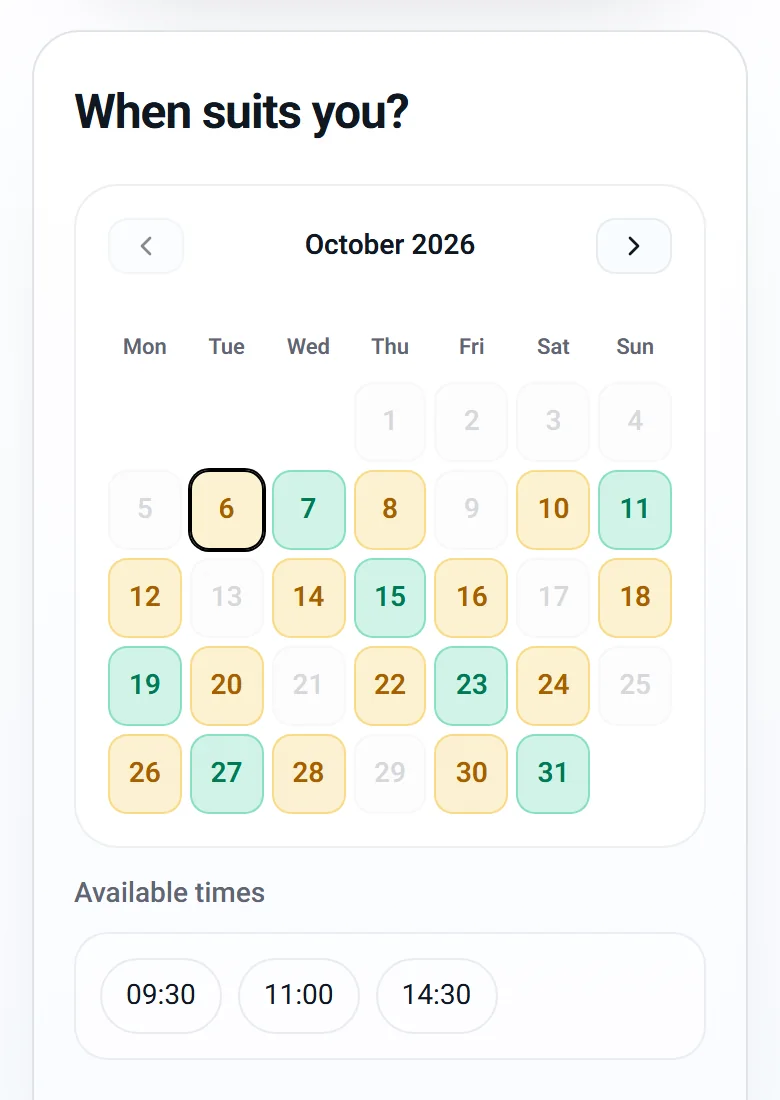
CalMov is online booking for businesses that travel to their customers. The customer enters their address first, and CalMov only offers times you can reach, allowing for the journey before and after each visit. Lite is free, with a fixed travel gap you set and up to two active services. Pro uses road-based drive times with expected traffic and can add travel charges by distance or drive time. The calendar shows the drive time between jobs and the drive back to base.
Time and price questions handle the pricing. Vehicle size and condition can be combined into one table, where each pair of answers sets the time and the price, and the customer sees the result as they answer. An answer like heavy pet hair can be set to 'Can't book online', which tells the customer to get in touch, or on Pro to 'We'll review it': the customer sends a request, the time is held, and you confirm, adjust the time or price, or decline. Site and access questions cover parking, power, water and space to work. Customers answer them in a short form after booking, and the answers are saved to the address for next time.
On Pro, Photos lets you take before and after pictures in job mode, up to 12 a job, and email the customer a report with the ones you pick. Customers cannot upload photos themselves yet, so ask for them by text or email when you need them for a quote. Saved vehicle profiles let a regular pick their car instead of typing it again.
Find your first 20 clients
Twenty customers on a monthly maintenance plan is about five cars a week before any one-time work. Regulars are easier to serve than rescue jobs, because the vehicle never gets bad and you already know the site.
- Start with neighbors, coworkers and family. Charge your real price and ask for honest feedback and a review.
- Create a Google Business Profile as a service-area business with your ZIP codes, packages, before and after photos (with permission) and your booking link.
- Post in neighborhood groups on Facebook and Nextdoor where the rules allow: one strong before and after, your area and how to book.
- Call on businesses with vehicles: contractors, real estate agents, rideshare and delivery drivers, small fleets and funeral homes. Offer a set day each month.
- Ask independent used-car dealers and body shops whether they need overflow help.
- Talk to property managers at office parks and apartment communities about an approved on-site day, and bring your insurance certificate and wash-water process.
- Before you leave each job, offer the next date. The same day every month is easy for a customer to keep.
- Leave a card in every finished car and ask who else on the street might want one done.
Your first month: a week-by-week checklist
Get the wash-water answer and the insurance in place before the first paid job. Then keep the early jobs few and close, so you learn about the work and not about traffic.
- Week 1: call the stormwater or wastewater agency for each city you will serve, and ask the city and county about a business license.
- Week 1: register the business, sort out your EIN and bank account, and get liability and commercial auto quotes that cover customers' vehicles.
- Week 2: set two or three packages with prices by vehicle size and condition, your ZIP codes, and your travel and weather rules.
- Week 2: load the rig, check the weight, and run two full practice details on friends' vehicles. Time every stage, including cleanup and water handling.
- Week 3: set up your booking page with vehicle and site questions, test it on a phone, and open booking in your core ZIP codes.
- Week 3: photograph every job before and after, with permission, and ask each customer for a review.
- Week 4: compare quoted and real times by vehicle size. Change any package that ran over twice.
- Week 4: pitch three fleets or property managers, move tax money into its own account and note the next estimated tax date.
Frequently asked questions
Do I need a license to start a mobile detailing business?
It depends on where you work. Expect to register the business with your state and to ask each city and county about a general business license. Some cities also require an authorization for commercial mobile washing. Portland, Oregon is one example. The SBA says license and permit needs depend on your activities and location.
Can wash water go down the storm drain?
Do not let it. The EPA explains that storm drains lead directly to local waterways, not to treatment plants, and cities such as Portland, Oregon prohibit commercial wash water from entering them. Ask your local stormwater agency how wash water must be collected and where it may be discharged.
Does waterless or rinseless detailing avoid local wash-water rules?
It cuts runoff sharply, which makes compliance much easier, but do not assume it exempts you. Describe your exact products and process to the local agency, and still check site permission and business license rules.
Do I need to carry my own water and generator?
Not always. Using the customer's water and power, by agreement, keeps your rig light and cheap. Carrying your own lets you work at apartments, offices and fleet yards. Choose based on the customers you want, and check your vehicle's payload before adding a tank.
What insurance does a mobile detailer need?
Ask an agent about general liability, cover for customers' vehicles while you work on them, your equipment, and commercial auto for your own vehicle. If you hire employees, the SBA says workers' compensation, unemployment and disability insurance are required. Get the terms in writing.
How much does it cost to start a mobile detailing business?
It ranges widely with the rig. An interior-focused setup in a car you own costs far less than a truck or trailer with a tank, generator and pressure washer. The SBA says registering a business usually costs under $300. For everything else, list one-time purchases, monthly costs and a reserve, and get quotes.
Can I detail cars at apartment complexes and office parks?
Only with the property's permission. Ask the manager, explain how you handle water and runoff, and offer your insurance certificate. HOA communities can have their own rules too, so ask the customer to check before they book.
How should I handle taxes as a self-employed detailer?
The IRS says self-employed people generally pay estimated tax quarterly and file an annual return. Self-employment tax is 15.3% of net earnings. Ask your state revenue department whether detailing is subject to sales tax, and set money aside from every job.
Sources and further reading
Sources used to check this guide. Check the linked guidance for current requirements, features and prices.
- Launch your business: registration, permits and insurance — U.S. Small Business Administration
- Apply for licenses and permits — U.S. Small Business Administration
- Get business insurance — U.S. Small Business Administration
- Self-employed individuals tax center — Internal Revenue Service
- Self-employment tax (Social Security and Medicare taxes) — Internal Revenue Service
- Get an employer identification number — Internal Revenue Service
- Standard mileage rates — Internal Revenue Service
- Stormwater best management practice: vehicle maintenance and washing — U.S. Environmental Protection Agency
- Portland, Oregon: Guide to the Mobile Washer Program — City of Portland Environmental Services
- Hazard communication: labels, safety data sheets and training — Occupational Safety and Health Administration
How CalMov helps
CalMov combines service duration, working availability and customer location to help mobile businesses offer bookable times that allow for the surrounding journeys.
See CalMov for US mobile detailers