
UK guide
Starting a mobile hairdressing business
How to start a mobile hairdressing business in the UK
A customer's kitchen may have room for a cut and blow dry but nowhere sensible to rinse a full head of colour. Mobile hairdressing works when you decide which services you can do well in a home, and build your kit, prices and booking questions around them. This guide covers the UK steps: registering with HMRC, council and insurance checks, colour safety, kit, your area, pricing, bookings and finding your first customers.
Quick answer
To start a mobile hairdressing business in the UK, register with HMRC as self-employed, ask your council whether it registers hairdressers, and insure yourself for work in homes and business driving. Choose a short menu you can deliver in a kitchen, set up allergy alert tests for colour, price each visit with travel and processing time included, and take bookings by address so you can always reach the next customer.
Is mobile hairdressing right for you?
It suits a qualified hairdresser who wants control of their own diary: school-hours work, evenings only, or a full week built around regulars. Your customers are people who cannot or would rather not sit in a salon. Think of older customers who want a weekly set, parents with a baby asleep upstairs, people who work from home, care home residents and bridal parties getting ready together.
The downsides are practical. You carry a heavy kit, often upstairs. You work around someone else's chair, sink, light and children. Colour is harder without a backwash, and you take the mess away with you. There are no colleagues to ask and no walk-ins on a quiet Tuesday. Travel time is unpaid unless you price for it, and a customer who cancels at the door costs you the drive as well as the slot.
You do not have to offer everything a salon does. A mobile business with five services you can time to the minute is easier to run, and to price, than one with thirty.
Register, tax and council checks
Sole trader is the usual starting point. GOV.UK says you must register for Self Assessment once you earn more than £1,000 from self-employment in a tax year, and tell HMRC by 5 October after that tax year ends. You can start trading before you register. If you are thinking about a limited company instead, GOV.UK notes it is usually easier to move from sole trader to limited company later than the other way round.
You pay Income Tax on your profit, plus National Insurance. GOV.UK lists Class 4 National Insurance at 6% on profits between £12,570 and £50,270 for the 2026 to 2027 tax year. The online return and payment are due by 31 January. VAT registration becomes compulsory if your taxable turnover passes £90,000. Making Tax Digital for Income Tax applies from 6 April 2026 if your qualifying income is over £50,000, and HMRC says that threshold drops to £30,000 in April 2027 and £20,000 in April 2028. Keep every receipt and record every sale from your first customer.
Hairdressing is not a licensed profession in the UK. The Hair and Barber Council holds the state register created by Parliament in 1964, and says registration is voluntary at present. Some hairdressers join to show they are qualified. In England, GOV.UK advises hairdressers to check with their local council, because you may have to register, and the council may charge a fee and inspect before it issues a certificate. Tell the council you work in customers' homes. Outside England, ask the council for each area you cover.
If you store names, addresses, phone numbers and colour records, look at the ICO's guidance on the data protection fee. It says organisations that use personal information, including sole traders, need to pay unless they are exempt.
Insurance, allergy alert tests and working safely
Business.gov.uk says motor insurance is a legal requirement when you use a vehicle in your business, and so is employers' liability once someone works for you. Ring your motor insurer, say you drive to customers and carry stock and tools, and ask them to confirm business use. Then get quotes for public liability and for treatment risk, which is the cover that deals with a claim about the service itself, such as a reaction to colour. List every service you offer. If a service is not on the policy, do not sell it.
Colour needs a process. NHBF guidance says an allergy alert test should be done at least 48 hours before the service, following the manufacturer's instructions for that product. It says you must record whether a test was needed, the date, the result and whether the service can go ahead, and that a new test is needed if the brand or product changes, if more than six months have passed or if the customer has reacted before. Check what your insurer and each manufacturer require, because their wording is the one you will be held to. Read the age warning on the product as well.
For a mobile hairdresser, the 48 hours is a scheduling problem. A new colour customer needs a short visit, or another agreed way to do the test, at least two days before the appointment. Build that into how you take bookings rather than sorting it out by text the night before.
HSE's advice for hairdressers covers your own health. Frequent wet work and some products can cause dermatitis, and dusty products such as persulphate bleach powders and henna can cause asthma. Wear disposable non-latex gloves for shampooing, colouring and bleaching, change them between customers, dry your hands well and moisturise. Keep the room ventilated: in a home that means asking to open a window when you mix and apply colour. HSE also says electrical equipment used for work must be kept safe, so check dryers, tongs and leads before each day.
Kit and car: a mobile hairdresser's starter list
Buy for your opening menu. Lay out everything for your longest service, pack it, and carry it from the car to a kitchen in one or two trips. Decide where clean kit sits during the service and where used towels and foils go afterwards.
Waste from your work, such as used foils, colour tubes and gloves, is business waste. GOV.UK says you must store it safely and dispose of it properly, and that you must register as a waste carrier if you want to dispose of your own waste regularly. In England that registration is usually free when you only carry waste your own business produced. Ask your council what trade waste options it offers.
For the car, HMRC's simplified expenses let you claim a flat rate per business mile instead of actual running costs: 55p for the first 10,000 miles in the 2026 to 2027 tax year, then 25p. Check the current rate and keep a mileage log. As for a start-up budget, write your own. List one-off purchases, monthly costs and a reserve, and fill in real quotes rather than a number from a forum.
- Scissors, thinning scissors, combs, brushes and sectioning clips.
- Hairdryer, straighteners, tongs, a heat mat and an extension lead.
- Gowns, capes and enough clean towels for the day, with a bag for used ones.
- A portable backwash basin or shampoo tray, a water spray and a jug.
- Colour bowls, brushes, foils, scales, a timer and the stock for booked services only.
- Disposable non-latex gloves, an apron, hand cream and tool disinfectant.
- Allergy alert test supplies and record cards, kept with your customer records.
- A floor sheet, a dustpan and brush, and bags for hair and waste.
- A mirror, a clip-on light, a card reader or payment link and a phone charger.
Set your service area and travel rules
A two-hour colour at the far end of the county can use most of an afternoon. Start with a tight area: a few neighbouring towns or postcodes you can cross in 15 to 20 minutes. Drive it at the times you will work. School-run traffic matters more to a hairdresser who works 9 to 3 than the mileage does.
Set the rules in advance. Decide how far you travel, whether there is a travel charge past a certain distance, and whether long services at the edge of the area need a minimum spend. One approach is to give each area its own days, so Monday's customers are all within a few minutes of each other. Tell customers the rules on your booking page and price list.
Check the sums before you promise a wide area. The calculator below compares what a near and a far postcode leave you, and the guide explains how to review the area once real bookings come in.
Price cuts and colour: worked examples
Every price has to pay for four things: your time in the home, the products, the drive, and the clearing up. These examples use invented figures. Put your own in.
A cut and blow dry: 50 minutes with the customer, 10 minutes setting up and clearing up, and 20 minutes of driving. That is 80 minutes. At £48, less £6 for products and vehicle costs, you keep £42, which works out at £31.50 an hour before insurance, tax and unpaid admin.
A colour and finish: 120 minutes in the home including development time, 15 minutes of setting up and cleaning, and 25 minutes of travel. That is 160 minutes. At £95, less £23 for colour, foils and the trip, £72 is left: £27 an hour. Development time is still your time. You are in the customer's home and responsible for the result, so do not treat it as free.
Hair length changes the sum. If long, thick hair adds 30 minutes and you charge the same £95, the £72 is spread over 190 minutes, about £22.74 an hour. A £15 supplement for long hair brings it to roughly £27.47. That is the case for short, medium and long prices, and for asking about length before the booking is confirmed.
Remember the allergy alert test visit for new colour customers. It takes travel time too, so decide whether you charge for it, combine it with a consultation, or absorb it into the colour price.
Take bookings without double-booking yourself
Two things catch mobile hairdressers out. The first is geography: a diary shows 1pm and 3pm as free, but not that the two homes are 40 minutes apart. The second is service length: a customer books a cut and blow dry, then asks on the day whether you can do her roots as well. Both are solved before the booking is confirmed. Ask for the address first, ask the questions that change the time, and block the drive either side.
A paper diary and a map can do this while you are small. The strain shows when enquiries arrive during a colour, or when a regular wants to move her slot and you have to work out the drive in your head.
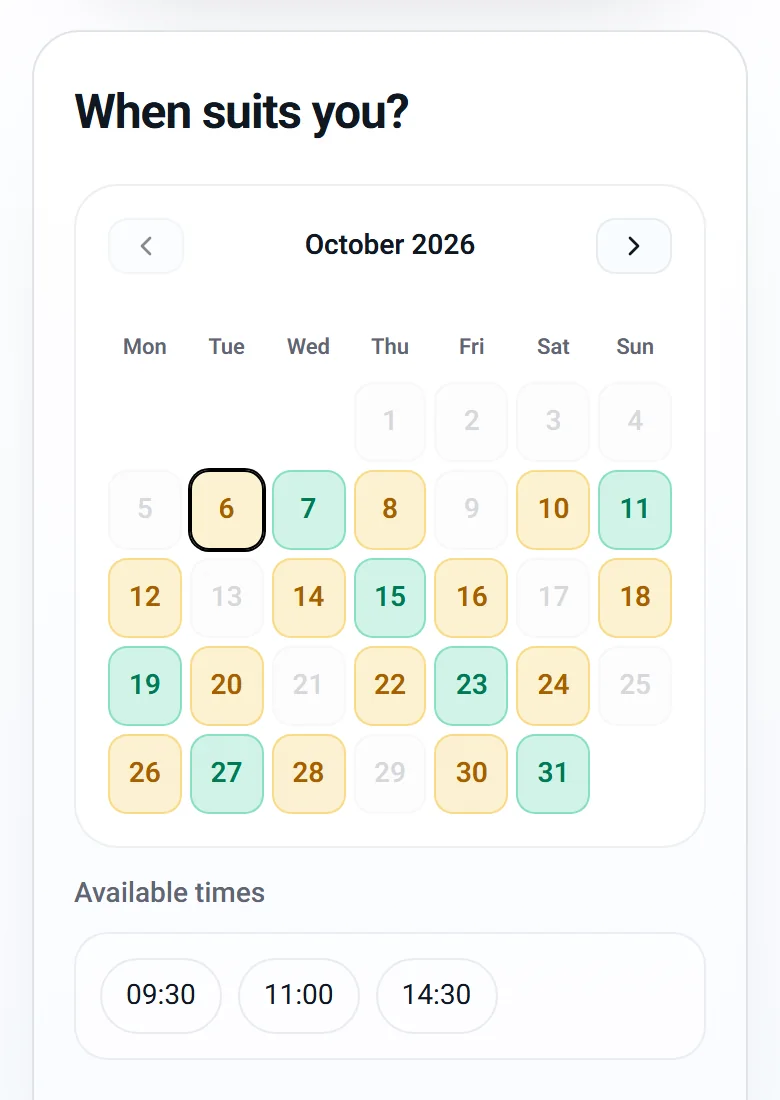
CalMov is online booking for businesses that travel to their customers. The customer enters their address first and only sees times you can reach, allowing for the journey before and after each visit. Lite is free and uses a fixed travel gap that you set, with up to two active services. Pro works from road-based drive times with expected traffic and can add travel charges by distance or drive time.
Two tools matter most for hairdressers. Checks before booking lets you say that colour needs an allergy alert test first, how long before the appointment it must be done (48 hours, for example) and how long a pass lasts. The colour service then shows what is needed and offers the customer your patch test service to book first. A customer without an in-date pass cannot book colour online, and you record each result as Passed or Failed. It is a booking rule, not a substitute for the manufacturer's instructions or your own judgement. Time and price questions let a hair length question change the service: each answer adds minutes and price, so long hair might add 30 minutes and £15, and the customer sees the total before they book.
Rebooking reminders email customers a link when they are due again, after the number of weeks you set for each service. Returning customers can reuse their saved details.
Find your first 20 customers
Twenty regulars is a real business: on a six-week cycle that is three or four bookings a week before anyone new calls. Most will come from people who already know you and from the streets you already drive down.
- Tell friends, family and past customers that you are open and where you cover. If you are leaving a salon, check your contract for terms about contacting its customers.
- Set up a Google Business Profile as a business that travels to customers, add photos of your work (with permission) and your booking link, and ask for reviews.
- Post in local Facebook groups where the rules allow, with your area, three clear services and how to book.
- Ring care homes and sheltered housing schemes. Ask who organises hairdressing, what insurance and checks they need to see, and whether a regular weekly morning is open.
- Introduce yourself to wedding venues, planners and make-up artists. Bridal mornings are booked months ahead, so start early.
- Leave cards at nurseries, community centres, cafes and with other mobile trades whose customers match yours.
- Book the next visit before you leave. Six weeks for a cut and the right gap for colour are easy to agree while the customer is looking at the result.
- Thank customers who refer a friend. A second customer on the same street costs almost no travel.
Your first month: a week-by-week checklist
Get the registration, insurance and allergy alert test process in place before the first paid visit. Then start with a light diary so you can measure what each service really takes.
- Week 1: check registration with your council, get insurance quotes that list every service, and tell your motor insurer about business use.
- Week 1: write your menu with short, medium and long prices, your area and your travel rules. Set up your allergy alert test routine and record cards.
- Week 2: pack the kit and rehearse your longest service at home, including rinsing and clearing up. Time each stage.
- Week 2: set up your booking page, test it on a phone with a near and a far address, and book three or four people you know.
- Week 3: open bookings in your core area. Record product used, time in the home and travel for every visit.
- Week 3: contact two care homes or wedding venues, and ask each customer for a review.
- Week 4: compare planned and real times, correct any service that overran, and adjust stock to what you really used.
- Week 4: set aside tax from every payment and put a monthly review of prices, area and costs in the diary.
Frequently asked questions
Do I need a licence to be a mobile hairdresser in the UK?
There is no compulsory national licence, and state registration with the Hair and Barber Council is voluntary. In England, GOV.UK says to ask your local council whether it requires hairdressers to register. Elsewhere in the UK, ask the council for each area you work in.
What insurance does a mobile hairdresser need?
Motor insurance that covers business use is a legal requirement when you drive for work, and employers' liability is required if you employ anyone. It is also sensible to get quotes for public liability, treatment cover and your kit. Ask the insurer to list every service you offer, including colour.
Do I need to do an allergy alert test before colouring at home?
Follow the manufacturer's instructions and your insurer's terms. NHBF guidance says the test should be done at least 48 hours before the service and recorded, and repeated if the product changes, six months have passed or the customer has reacted before. Plan a short earlier visit for new colour customers.
How much does it cost to start a mobile hairdressing business?
It depends on the kit you own and the services you offer. Cutting and styling need little beyond tools, insurance and a car. Colour adds stock, a portable basin and test supplies. Make three lists (one-off purchases, monthly bills, a cash reserve) and fill them with real quotes.
Should I offer every salon service when I start?
No. Offer what you can do reliably with your training, your kit and an ordinary kitchen. Leave colour corrections and anything you cannot time as an enquiry first. Add services once your timings and prices are dependable.
Can I fit another customer in while colour develops?
Not safely as a rule. You are in the customer's home and responsible for the colour while it develops, and the next customer is a drive away. Price the development time as part of the appointment instead.
How do mobile hairdressers charge for travel?
Three common ways: include travel in the price inside a small area, add a set charge beyond a certain distance, or set a minimum spend for far addresses. Whichever you choose, publish it before customers book and check it against your real drive times.
Can I work from home as well as visiting customers?
Possibly, but it is a different set-up. Ask your council about registration and planning, and tell your home and business insurers. Check your mortgage or tenancy terms too. Keep it separate in your booking set-up, because a visit at your home has no drive to allow for.
Sources and further reading
Sources used to check this guide. Check the linked guidance for current requirements, features and prices.
- Become a sole trader: responsibilities and registration — GOV.UK
- Register as a sole trader: who must register and by when — GOV.UK
- Set up a business: sole trader, limited company and other structures — GOV.UK
- Self Assessment tax returns: deadlines — GOV.UK
- Self-employed National Insurance rates — GOV.UK
- How VAT works: VAT thresholds — GOV.UK
- Find out if and when you need to use Making Tax Digital for Income Tax — HM Revenue and Customs
- Hairdresser and barber registration in England — GOV.UK
- About the Hair and Barber Council and voluntary state registration — The Hair and Barber Council
- The data protection fee — Information Commissioner's Office
- Insuring your business — Business.gov.uk
- Allergy alert tests, industry tests and your insurance — National Hair and Beauty Federation
- COSHH and hairdressers: working with hairdressing products — Health and Safety Executive
- Portable appliance testing: frequently asked questions — Health and Safety Executive
- Dispose of business or commercial waste: your responsibilities — GOV.UK
- Register or renew as a waste carrier, broker or dealer (England) — GOV.UK
- Simplified expenses if you're self-employed: vehicles — GOV.UK
How CalMov helps
CalMov combines service duration, working availability and customer location to help mobile businesses offer bookable times that allow for the surrounding journeys.
Explore booking for mobile hairdressers