UK & US guide
Calendly and CalMov for mobile services
Calendly alternative for mobile businesses: when CalMov fits
You can be free at 14:00 and still be unable to reach a customer's house by 14:00. Calendly is very good at finding a time when two people are free. It was not built to ask where the next job is. This guide covers what Calendly does well, the real steps for adding travel time in it, and where CalMov does something different. We checked Calendly's own pages on 5 October 2026.
Quick answer
Calendly can hold a fixed buffer before and after each booking, and it can ask the customer for a location. A Calendly community manager has written that there is no way to work out the travel buffer between two addresses automatically. CalMov asks for the customer's address first and only offers times you can reach. Stay with Calendly for calls, meetings and teams. Look at CalMov if your work happens at a different address every time.
What Calendly does well, and who should stay with it
Calendly's scheduling page describes connected calendars, event types for one-to-one and multi-person meetings, buffers, daily meeting limits, routing forms, reminders, payment tools and more than a hundred integrations. Its location options include video tools such as Zoom, Google Meet and Microsoft Teams.
It is also easy for the person booking. They open a link, pick a time and get a calendar invite. For calls, consultations at your own premises and meetings that involve colleagues, that is the whole job done.
Stay with Calendly if most of your bookings are calls or video meetings, if customers come to one address, if a team shares the bookings between them, or if your other software depends on its integrations. CalMov does not have team routing or that range of integrations.
Where Calendly falls short for mobile work
Calendly's location guide lists several options for an event type. In-person means you enter the meeting address. Ask invitee adds a location question that the customer fills in on the booking page. The location then appears on the confirmation page, in the calendar event and in the notifications.
So Calendly can collect an address. The guide does not say the address changes which times are offered. In a post on Calendly's community site in June 2025, a Calendly community manager wrote that there isn't any way right now to automatically determine the length of travel buffer needed between two addresses. The suggestion there is to adjust buffers by hand, or to make one event type for each location.
We also couldn't find a Calendly setting for a service area by distance or drive time. Anyone with your link can book, wherever they are, unless you screen them with a question.
How to handle travel time in Calendly today
If you are staying with Calendly, these are the steps its help pages describe. Buffers are listed as available on all plans.
Three details from Calendly's buffer guide are worth knowing. Before and after buffers stack between two bookings. Buffers on bookings already made don't update when you change the setting. And a buffer can run past the end of your working hours, so the last booking of the day can still be taken at closing time.
- On the Scheduling page, find the event type, open its menu and choose Edit.
- Open More options, then Limits and buffers. Choose Set buffer time and add minutes before, after, or both. Save changes.
- In the Location section, choose Ask invitee, so each customer gives their address when they book.
- Set a minimum scheduling notice so nobody books a visit an hour from now on the far side of town.
- If you work in distinct areas, follow Calendly's own tip: one event type per area, each with a before buffer that suits that area. The Free plan has one event type, so this needs a paid plan.
- Each time a booking arrives, check the address against the visits either side, and move it if the drive doesn't fit.
A worked day: four visits with fixed buffers
This is an example with made-up customers and drive times. A mobile business has four one-hour visits. The event type has a 15-minute buffer before and a 15-minute buffer after. Calendly's guide says these stack, so 30 minutes is held between any two bookings.
The first gap wastes 23 minutes. The second is 11 minutes too short, so customer C is kept waiting. The third gap happens to absorb the delay. One fixed number can't be right for all three drives.
Nova Fades, a mobile barber in London, used Calendly with fixed travel buffers before moving to CalMov. Its case study describes a 20-minute buffer protecting a drive of about two minutes. Those figures were reported by the customer, and one business is not proof of what yours will see.
| Customer | Booked time | Drive from the last visit | What happens |
|---|---|---|---|
| A | 09:00 to 10:00 | From base | Starts on time |
| B | 10:30 to 11:30 | 7 minutes | Arrives 10:07 and waits 23 minutes |
| C | 12:00 to 13:00 | 41 minutes | Arrives 12:11, 11 minutes late |
| D | 13:30 to 14:30 | 14 minutes | Visit C ends 13:11, arrives 13:25, on time |
The same day in CalMov
In CalMov the customer enters their address first, then picks a service and a time. CalMov only offers times you can reach, allowing for the journey before and after each visit. You can limit your service area by distance or by drive time.
On Pro, the drive times come from the roads, with expected traffic. In the example, customer C is not offered 12:00, because the 41-minute drive from B doesn't fit. The first start that fits is after 12:11. Customer B can be offered a start sooner than 10:30, because the drive from A is seven minutes.
On the free Lite plan, CalMov uses a fixed travel gap that you set. That behaves much like a Calendly buffer. If a buffer already works for you in Calendly, Lite alone is not a reason to move.
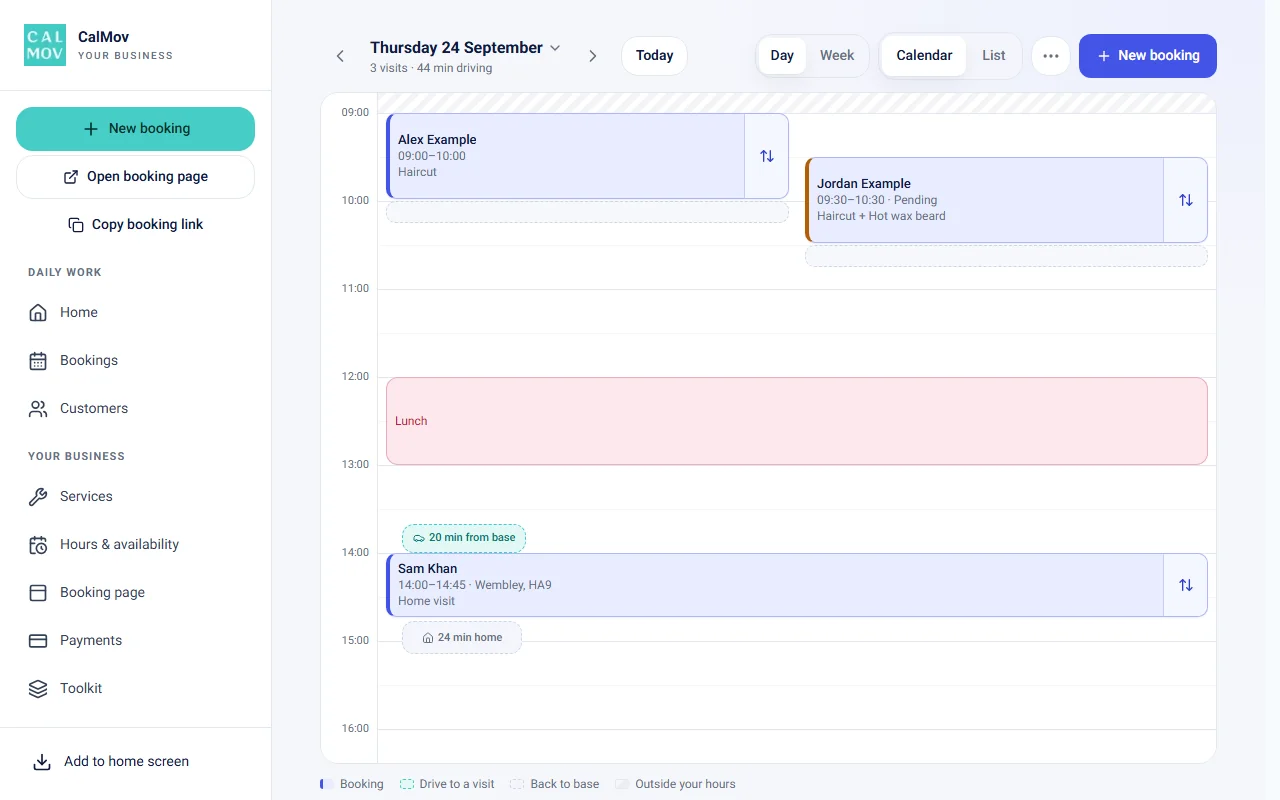
Your calendar shows the drive between visits and the drive back to base. Drag a booking to a new time and CalMov checks that it fits, including the drive.
What else a mobile business gets in CalMov
Calendly is a general tool, so it doesn't come set up for what a dog groomer or a car detailer needs to know before a job. CalMov asks for your trade at sign-up and uses your words: client, pet, vehicle, property. Its Toolkit has eight tools, each switched on or off by you.
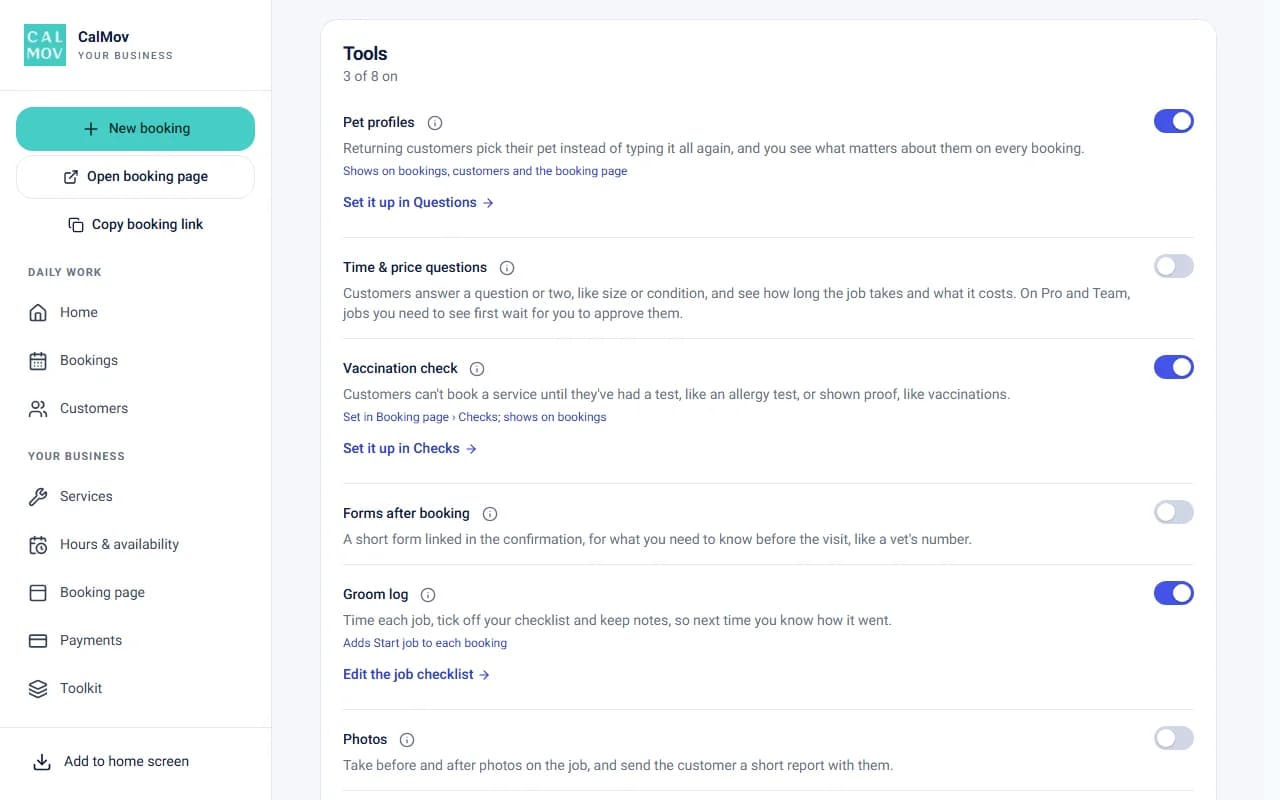
- Saved profiles: a returning customer picks a saved pet, vehicle, property or person instead of typing the details again.
- Time and price questions: an answer can add minutes and money to a service, such as a large dog or a matted coat. Lite allows one such question per service, or two combined. Pro allows up to ten.
- Checks before booking: say what must be done first, such as an allergy alert test, and how long a pass lasts.
- Forms after booking and Site & access: questions about parking, power, water or a door code, asked after the booking and saved to the address.
- Visit records: tap Start job for a timer against the estimate and notes. Pro adds a checklist.
- Photos (Pro): before and after photos, and a report you can email to the customer.
- Rebooking reminders: an email with a booking link when a customer is due again.
Cost and plans compared
Calendly's pricing page lists a Free plan with one event type and one calendar connection. Standard is shown from $10 per seat a month and Teams from $16 per seat a month, with the exact figure depending on whether you pay monthly or yearly. Standard adds unlimited event types, reminders and payments. Teams adds round-robin and team scheduling. The prices we saw were in US dollars.
CalMov Lite is free, with up to two active services, a fixed travel gap, the booking page, the calendar and confirmations. CalMov Pro is £22 a month at the founder price and £29 as standard ($29 and $39 in the US), with a 14-day free trial and no card. Pro adds road-based drive times, travel charges by distance or drive time, unlimited services, add-ons and online payments through Stripe (included on Pro; Lite can add them as an upgrade with a 30p fee per paid booking, in the UK). A Team plan, for more than one person, is in pilot.
Calendly's paid plans cost less than CalMov Pro. If a fixed buffer does the job, that is money well saved. CalMov Pro earns its price only when wrong gaps and manual checks are costing you more than the difference.
| Question | Calendly | CalMov |
|---|---|---|
| Customer's address | Can be asked with the Ask invitee location | Asked first, before any times are shown |
| Gap between visits | Fixed buffers before and after | Lite: a fixed gap you set. Pro: road-based drive times |
| Service area | We couldn't find a setting | By distance or by drive time |
| Teams and routing | Yes, on the Teams plan | Team plan in pilot |
| Free plan | One event type | Up to two active services |
How to switch from Calendly, or run both
Running both is common and sensible. Keep Calendly for discovery calls and video meetings, and use CalMov for visits at the customer's address. Connect both to the same Google Calendar or Outlook calendar. CalMov adds its bookings there and treats busy times as unavailable, so a call that sits in your calendar blocks a visit in CalMov.
If you are moving your visits over, take it in steps.
- List your future bookings with their addresses, and any payments already taken.
- Set up CalMov Lite for free: your services, hours, service area and a travel gap.
- Connect your calendar so existing commitments block your CalMov times.
- Book yourself in from a phone with a near address and a far one. Check the times offered.
- Swap the link in one place first, such as your website button, and watch a week of bookings.
- Leave your Calendly link live for calls, and stop sharing it for visits.
Frequently asked questions
Can Calendly calculate travel time between appointments?
Not from the addresses. Calendly's buffer guide describes a fixed number of minutes before and after a booking. A Calendly community manager wrote in June 2025 that there isn't any way right now to work out the travel buffer needed between two addresses automatically. You choose the buffer yourself.
Should I switch if a fixed buffer already works?
Probably not for travel alone. If your visits are close together and you rarely move a booking because of the drive, the buffer is doing its job. Look at CalMov if another part of it would help, such as the Toolkit or a service area.
Does CalMov replace Google Calendar?
No. CalMov works with Google Calendar, Outlook and iCloud. Bookings are added to your calendar, and busy times in your calendar block your CalMov availability. You keep using the calendar you already have.
Is CalMov good for video calls and meetings?
It can take bookings for online services and add a Google Meet link. But meetings are what Calendly is built for, with team scheduling, routing and many integrations. If you mostly book calls, Calendly is the better fit.
Can I use CalMov for a team?
Only in a pilot. Lite and Pro are for one person, and the Team plan is in pilot: ask to join at enquiry@calmov.com. Calendly's Teams plan handles shared and round-robin scheduling today.
Does CalMov need an app?
No. CalMov runs in your phone's browser, and there is nothing to install. Your customers book from a link or from the booking page embedded on your website.
Sources and further reading
Official provider information reviewed for this comparison. Product features, prices and limits can change, so check every essential requirement on the provider's current pages.
- Calendly scheduling capabilities — Calendly
- Calendly: how to use buffers — Calendly
- Calendly: how to set the location for your event type — Calendly
- Calendly: how to fine-tune your availability settings — Calendly
- Calendly Community: using buffers for travel time — Calendly
- Calendly pricing — Calendly
- Nova Fades customer case study — CalMov
How CalMov helps
CalMov combines service duration, working availability and customer location to help mobile businesses offer bookable times that allow for the surrounding journeys.
Explore CalMov's travel-time scheduling