
US guide
Starting a US mobile barber business
How to start a mobile barber business in the US
In the US, the first question is not which clippers to buy. It is whether your state lets a licensed barber cut outside a licensed shop, and on what terms. Some states issue a permit for house calls. Some license a self-contained mobile unit. The answer decides what you can sell, what you need to buy and where you can park. This guide starts there, then covers registration, taxes, insurance, pricing, booking and your first clients.
Quick answer
To start a mobile barber business in the US, ask your state barber board what a licensed barber needs to work outside a shop, then register the business, get an EIN if you need one, and check city and county licenses. Buy liability and auto cover that fit mobile work, set a small group of ZIP codes, price each stop with the drive included, and book by address so travel time is built into the day.
Is mobile barbering a good fit for you?
It fits a licensed barber who wants to own the schedule and keep what a booth rent or commission split would take. The clients are people who value not driving to a shop: busy professionals, parents, older adults, people recovering at home, wedding parties and offices that want cuts on site. Regulars who book every few weeks are the core of the business.
The trade-offs are real. You will cut fewer heads in a day because each one comes with a drive. There is no walk-in traffic. You carry gear into apartments, look for parking and deal with gate codes. Gas, tolls and wear on your vehicle come out of every ticket. And you are your own front desk, so messages arrive while you are holding clippers.
There are two ways to run it. With house calls you carry a kit into the client's home or office. With a mobile unit you cut inside a converted truck, van or trailer. States often treat these as two different things, so decide which one you are asking about before you call the board.
| Question | House calls | Mobile barber unit |
|---|---|---|
| Where you cut | Inside the client's home, office or event space. | Inside your own truck, van or trailer, parked at or near the client. |
| Licensing to ask about | Whether your state allows off-site services and which permit covers them. | Whether your state licenses mobile shops and what the unit must contain. |
| Startup spending | A portable kit, sanitation supplies and the car you drive now. | The vehicle, the build-out, water and power on board, storage and upkeep. |
| Biggest limit | The services your state allows off site, plus setup and cleanup time at each stop. | Where you are allowed to park and operate, and downtime when the unit needs repairs. |
Check your state barber board before anything else
Barbers are licensed by a state board, and each board sets its own rules for work outside a licensed shop. Call or email yours with a plain description: cutting in private homes, cutting at offices or events, or cutting inside a vehicle. Ask what license or permit covers it, which services are allowed, and what records you must keep. Get the answer in writing. A city business license or an LLC filing does not answer this question.
California shows how specific the rules can be. Its Board of Barbering and Cosmetology issues a Personal Service Permit for limited services outside a licensed establishment. The board's own questions and answers say an applicant must have held a valid license for at least two consecutive years, submit fingerprints, pay a $25 application fee and show liability insurance of at least $1,000,000. A barber with the permit can shampoo, cut and style hair and trim beards, but the list does not include dyeing, relaxing or chemical waving. After each service the client gets a consumer notice and signs a receipt, which you keep for five years.
Texas takes a different route for vehicles. The Texas Department of Licensing and Regulation licenses a mobile establishment, which it defines as a self-contained, enclosed mobile unit. Its page lists a $78 application fee, a two-year license, a permanent address the unit returns to, an onboard water heater and holding tank, and either GPS tracking or a weekly itinerary sent at least seven days ahead. It also says services may not be performed outside the unit.
These are two examples, not national rules. Your state may be stricter, looser or silent, and a neighboring state can be different again. If you plan to work across a state line, ask both boards. Do not buy a truck or advertise house calls until your own board has told you what it allows.
Register the business and plan for taxes
With the licensing route clear, set up the business itself. The SBA's launch guide walks through the steps: choose a structure, register, get tax IDs, apply for licenses and permits, open a business bank account and buy insurance. The two structures a solo barber usually compares are a sole proprietorship and a single-member LLC. The SBA notes that your structure affects your taxes, your paperwork and your personal liability, so it is worth an hour with an accountant or a business counselor. The SBA also says registering usually costs less than $300 in total, though fees vary by state and structure.
An Employer Identification Number is free from the IRS, and both the IRS and the SBA warn against websites that charge for one. The IRS lists who needs an EIN, including anyone who hires employees or runs a corporation or partnership. The SBA notes that a sole proprietor can open a business bank account with an EIN or a Social Security number. Then check city and county rules. The SBA says the licenses and permits you need depend on your business activities and location, so a general business license in each city you serve is worth asking about. If you trade under a name that is not your own, ask your state or county about registering a DBA.
Taxes work differently once nobody withholds for you. The IRS says self-employed people generally must file an annual return and pay estimated tax each quarter, using Form 1040-ES. Self-employment tax is 15.3% of net earnings: 12.4% for Social Security and 2.9% for Medicare. You have to file if your net earnings from self-employment are $400 or more. Put a share of every payment into a separate account so the quarterly bill does not surprise you. Ask your state revenue department whether haircuts or the products you sell are subject to sales tax where you work.
Insurance and sanitation on the road
The SBA's rule of thumb is to insure against things you could not pay for yourself. For a barber working in clients' homes, the two policies to price first are general liability, which the SBA describes as cover for bodily injury and property damage, and professional liability, which covers claims of negligence in the service itself. Tell the agent exactly where you work. Some states set a floor: California's Personal Service Permit requires proof of at least $1,000,000 in liability cover.
Call your auto insurer too. Ask whether your personal policy covers driving to paying clients with tools in the car, or whether you need business use or a commercial policy. Get the answer in writing. Ask about cover for your tools, and for the build-out if you run a mobile unit.
If you hire, the rules change. The SBA says the federal government requires every business with employees to carry workers' compensation, unemployment and disability insurance, and some states add more. OSHA's hazard communication standard also requires employers to keep safety data sheets and train workers on the chemicals they use.
Sanitation rules follow you out of the shop. Your state board's rules on disinfecting tools, clean and used linens, and single-use items apply wherever you cut, and a permit can add its own conditions. Carry enough clean capes and towels for the whole day, a covered container for used ones, and an approved disinfectant. Keep a sharps container for used blades.
Kit and vehicle: what a mobile barber needs
Build the kit around the services your board allows off site and the cuts you will sell in month one. Pack it, carry it up a flight of stairs and time a full setup and cleanup before you take a paid booking.
Your car is a business tool now. The IRS standard mileage rate for business driving is 76 cents a mile from July 1 to December 31, 2026 (it was 72.5 cents for the first half of the year). Check the current rate on the IRS page, and log every business trip with the date, miles and purpose. For a mobile unit, get written quotes for the vehicle, the build-out to your state's standard, insurance, storage and maintenance, and ask the builder which state inspections their units have passed. There is no honest one-size startup figure. Write three lists (one-time purchases, monthly bills and a cash reserve) and fill them with your own quotes.
- Clippers, trimmers and guards, with a backup clipper or spare battery.
- Shears, combs, a razor with single-use blades and a sharps container.
- Capes, neck strips and clean towels for a full day, plus a covered bin for used linens.
- Disinfectant approved for tools in your state, surface wipes and hand sanitizer.
- A portable mirror, a clip-on light and a folding stool or portable chair.
- A floor mat, a hand vacuum or brush and pan, and trash bags.
- An extension cord and a way to charge tools in the car.
- A card reader or payment link, a phone mount and a charger.
- Copies of your license and any permit, plus the consumer notices or receipts your state requires.
Choose your ZIP codes and travel rules
Start with one cluster of neighborhoods. Drive between them at the hours clients will ask for, including freeway ramps, tolls and school pickup. A ZIP code is a handy way to tell clients where you go, but it does not tell you whether two appointments fit back to back. Check parking as well: apartment garages, permit streets and downtown meters all add minutes.
Write the travel rules before you take the first booking. How many miles or minutes will you drive? Is travel included inside the core area? What is the fee beyond it? Is there a minimum, such as two cuts, for the farthest ZIP codes? Will you work the north side on set days so the drives stay short? Post the rules where clients book.
Then test the numbers. The service area calculator shows what a far ZIP code leaves after the drive, and the service area guide explains how to review your boundary every month.
Price a house-call haircut: a worked example
Price the stop, not the haircut. Start with a short menu: a standard cut, a fade, a cut with beard trim, a kid's cut and a price for each extra person at the same address. State what is included and how long it takes.
This example uses made-up numbers, so swap in your own. Allow 40 minutes cutting, 10 resetting your gear, 25 driving and 5 parking and getting in. That is an 80-minute stop. At $65, less $10 for supplies and trip costs, you keep $55, which is $41.25 for each hour the stop takes up. That is before insurance, self-employment tax, your phone, slow days and unpaid admin. It is not take-home pay.
Now try an address 20 minutes farther out. The same $55 is spread over 100 minutes, which is $33 an hour. A $15 travel fee takes it to $42 an hour. That one comparison tells you whether to charge for distance, tighten the area or ask for two cuts at far addresses.
Do not build the price on tips. They are welcome, but they do not show up on the days you need them. After your first 20 stops, compare planned time with real time and fix the services that ran long.
Take bookings without double-booking your day
A shop calendar only has to stop two people booking the same chair at the same time. Yours has to stop two addresses that are 35 minutes apart from landing 15 minutes apart. A scheduling app built for shops does not ask where the client lives before it offers a time, so it can sell a slot you cannot reach. The rule that fixes it: get the address first, then offer times with the drive blocked before and after.
You can run that by hand for the first few weeks with one calendar, a fixed gap after every cut and a map check before you confirm. It breaks down when requests come in by text while you are working, or when a client asks to move and the new time looks free but is across town.
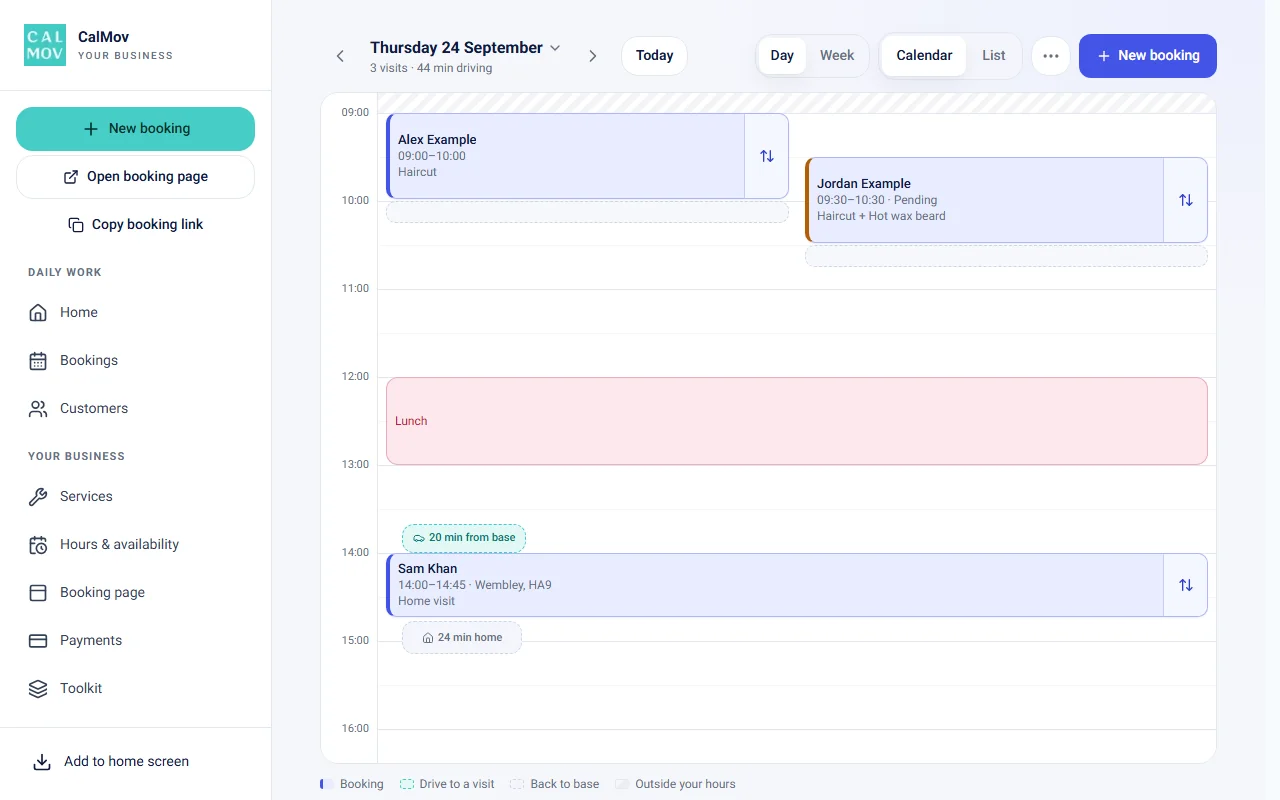
CalMov is online booking for businesses that travel to their clients. The client enters their address first, and CalMov only offers times you can reach, allowing for the journey before and after each visit. Lite is free, with up to two active services and a fixed travel gap you choose. Pro uses road-based drive times with expected traffic and can add travel charges by distance or drive time. The calendar shows the drive time between visits and the drive back to base. It runs in the phone's browser with nothing to install.
For barbers, the record of each visit is called Cut notes: tap Start job, see a timer against your estimate and write down what you did, so the next cut starts from the last one. Each service has a rebooking reminder, filled in at three weeks for barbers. About a week before a client is due, CalMov emails a link that opens your booking page on the same service around their due date. On Pro, group bookings with a discount handle a family at one address. Email is the channel here; CalMov does not send text messages.
Find your first 20 clients
Twenty regulars who rebook every three weeks is about seven cuts a week before a single new client finds you. Most of them will live or work within a few miles. Start close and work outward.
- Tell the people who already trust your work. If you rent a booth or work on commission, read your agreement first for anything about taking clients.
- Create a Google Business Profile as a service-area business, list the ZIP codes you cover and add your booking link. Ask every happy client for a review.
- Post in neighborhood groups on Facebook and Nextdoor where the rules allow. Show a cut with the client's permission, name your area and link to booking.
- Call senior living communities and assisted living facilities. Ask who schedules barber visits, what paperwork they need and whether a regular morning would help.
- Pitch on-site cut days to offices, fire stations, car dealerships and gyms.
- Reach out to wedding planners and venues for groomsmen cuts on the morning of the event.
- Offer the next date before you pack up. A client who rebooks at the door does not have to be won again.
- Hand each client two cards. A referral on the same street costs you almost no drive time.
Your first month, week by week
Finish the licensing and insurance before the first paid cut. Then open slowly enough that you can write down what really happens at each stop.
- Week 1: get your state board's answer in writing, apply for any permit, and ask the city and county about a business license.
- Week 1: register the business, get an EIN if you need one, open a business bank account and get liability and auto quotes.
- Week 2: write your menu, prices, ZIP codes and travel rules. Pack the kit and rehearse a full stop at home, cleanup included.
- Week 2: set up your booking page and test it on a phone with a close address and a far one. Book three or four people you know and time every stage.
- Week 3: open booking in your core ZIP codes only. Ask for a review after each cut and offer the next date.
- Week 3: contact two senior communities or workplaces and follow up within the week.
- Week 4: compare planned and real times, fix services that ran long, and check what each ZIP code left after the drive.
- Week 4: move money for taxes into a separate account, note the next estimated tax due date and set a monthly review of prices and area.
Frequently asked questions
Can a licensed barber make house calls in any state?
No, do not assume so. Each state board sets its own rules for work outside a licensed shop. California, for example, requires a Personal Service Permit and limits the services you can offer under it. Ask your own board, in writing, before you advertise house calls.
Do I need a special license for a barber truck or van?
Often, yes. Some states license the mobile unit itself, separately from your barber license. Texas, for example, licenses a mobile establishment and sets rules for water, equipment and reporting where the unit will be. Ask your state board what applies to a vehicle before you buy or build one.
Do I need an LLC to start a mobile barber business?
No single structure is required. A sole proprietorship and a single-member LLC are the two a solo barber usually compares. The SBA explains that your structure affects taxes, paperwork and personal liability, so compare them or ask an accountant before you register.
Do I need an EIN if I work alone?
Check the IRS list of who needs one. The SBA notes that a sole proprietor can open a business bank account with an EIN or a Social Security number. An EIN is free from the IRS, so never pay a website to get one.
How much does it cost to start a mobile barber business?
It depends on the model. House calls mostly need a portable kit, insurance, permits and supplies. A mobile unit adds the vehicle and build-out. Known fees are small: the SBA says registering a business usually costs under $300, California's permit application is $25 and Texas's mobile establishment application is $78. Get quotes for everything else.
How do taxes work for a self-employed barber?
The IRS says self-employed people generally file an annual return and pay estimated tax quarterly. Self-employment tax is 15.3% of net earnings, and you must file if your net self-employment earnings are $400 or more. Set money aside from every payment and consider a tax professional for your first year.
Should I buy a barber truck before I have clients?
Confirm the licensing route, the full build cost and a realistic service area first. Where your state allows house calls, they are a lower-cost way to test demand. Only take paid work once the license, permits and insurance for your model are in place.
How do I stop long drives from eating my day?
Take the address before you offer a time, keep to a small group of ZIP codes and work each side of town on set days. Booking software that checks the drive before and after each visit, such as CalMov, only shows clients the times you can reach.
Sources and further reading
Sources used to check this guide. Check the linked guidance for current requirements, features and prices.
- California: Personal Service Permit information — California Board of Barbering and Cosmetology
- California: Personal Service Permit questions and answers — California Board of Barbering and Cosmetology
- Texas: mobile barbering and cosmetology establishment licenses — Texas Department of Licensing and Regulation
- Launch your business: registration, permits and insurance — U.S. Small Business Administration
- Apply for licenses and permits — U.S. Small Business Administration
- Get business insurance — U.S. Small Business Administration
- Self-employed individuals tax center — Internal Revenue Service
- Self-employment tax (Social Security and Medicare taxes) — Internal Revenue Service
- Get an employer identification number — Internal Revenue Service
- Standard mileage rates — Internal Revenue Service
- Hazard communication: labels, safety data sheets and training — Occupational Safety and Health Administration
How CalMov helps
CalMov combines service duration, working availability and customer location to help mobile businesses offer bookable times that allow for the surrounding journeys.
Explore CalMov for US mobile barbers