
US guide
Starting a US mobile styling business
How to start a mobile hair stylist business in the US
A blowout in a client's living room and hair for a six-person wedding party are both mobile styling, but they are different businesses. One depends on a workable space and a short drive to the next client. The other depends on everyone being ready by a fixed time. Before either, your state cosmetology board decides which services you may perform outside a salon at all. This guide covers that check first, then registration, taxes, insurance, kit, pricing, booking and finding clients.
Quick answer
To start a mobile hair stylist business in the US, ask your state cosmetology board which services a licensed stylist may perform outside a salon and what permit that takes. Then register the business, sort out tax IDs and local licenses, and buy liability and auto cover. Pick house calls, events or a licensed mobile salon, price setup and drive time into every service, and book by address so each client is reachable.
Is a mobile styling business right for you?
It works for a licensed stylist who wants to choose their own hours and clients and stop paying booth rent. The demand comes from people who cannot easily get to a salon or would rather not: new parents, clients who work from home, older adults, people recovering from surgery, and brides who want hair done where they are getting dressed.
Know what you give up. A salon has a shampoo bowl, good light, a color bar and a front desk. On the road you have what fits in your car and what the client's home offers. You carry the kit, protect the floor, find parking and clean up before you go. You will see fewer clients a day because every one comes with a drive. Event work can fill a morning with one booking, but it takes your weekends and comes with hard deadlines.
There are three models. House calls for regular services. On-location styling for weddings, shoots and events. Or a mobile salon built into a vehicle. Each one can fall under different state rules, so pick the one you are starting with before you call the board.
Ask your state cosmetology board what is allowed off site
Cosmetology is licensed state by state, and so is the question of where you may work. Send your board a list of the services you want to offer and the places you want to offer them: private homes, hotels and venues, or inside a vehicle. Ask which license or permit covers each, what is excluded, and what notices or records you must keep. Keep the reply.
California is a clear example of limits. Its board issues a Personal Service Permit to licensees who have held a valid license for at least two consecutive years, submit fingerprints, pay a $25 application fee and show at least $1,000,000 in liability insurance. Under the permit a cosmetologist may shampoo, cut, style, curl and wave hair and apply makeup. The board's list says those services do not include dyeing, relaxing or chemically waving the hair. So in California a house-call business under this permit is a cutting and styling business, not a color business. Each client must get a consumer notice and sign a receipt, which you keep for five years.
Vehicles are often handled separately. Texas licenses a mobile establishment, defined as a self-contained, enclosed mobile unit, with a $78 application fee and rules on hot water, holding tanks and reporting where the unit will be. Florida law requires a mobile cosmetology salon to keep a permanent business address, file a written monthly itinerary with the board before each month begins, and comply with local laws and ordinances.
None of these three is the rule where you live unless you live there. Use them as a list of questions for your own board: Can I work in homes? Which services? Do I need a permit? Does a vehicle need its own license? What do I hand the client?
Set up the business: structure, tax IDs and local licenses
The SBA's launch guide lists the steps in order: choose a structure, register, get federal and state tax IDs, apply for licenses and permits, open a business bank account and get insurance. A sole proprietorship is the simplest structure and an LLC is the usual alternative. The SBA points out that the choice affects taxes, paperwork and personal liability, and that registering generally costs less than $300 in total, depending on your state and structure.
An EIN is free from the IRS. The IRS and SBA both warn about websites that charge for one. Check the IRS list of who needs an EIN; the SBA notes a sole proprietor can open a business bank account with an EIN or a Social Security number. For local rules, the SBA says the licenses and permits you need depend on your activities and location. Ask each city and county you will work in whether a general business license applies to a stylist who visits clients. California's board says the same in its permit guidance: a permit holder still has to follow whatever license or permit the local government requires.
On taxes, the IRS says self-employed people generally file an annual return and pay estimated tax quarterly with Form 1040-ES. Self-employment tax is 15.3% of net earnings, made up of 12.4% for Social Security and 2.9% for Medicare, and you must file if net self-employment earnings are $400 or more. Move a set share of every payment into a tax account. Ask your state revenue department whether services, or the retail products you sell, are taxed in your state.
Insurance, color safety and sanitation
Start with the SBA's list of common policies. General liability covers bodily injury and property damage, such as a hot tool on a client's countertop. Professional liability covers claims about the service itself. Tell the agent you work in homes and venues, and name every service. Some permits set a minimum: California asks for $1,000,000 in liability cover. Wedding venues may ask for a certificate of insurance before you can work on site.
Ask your auto insurer whether your personal policy covers driving to clients with equipment in the car, and get the answer in writing. If you bring on an assistant as an employee, the SBA says federal rules require workers' compensation, unemployment and disability insurance, and OSHA's hazard communication standard requires employers to keep safety data sheets and train staff on the chemicals they handle.
If your state lets you offer color off site, treat it with the same care as in a salon. The FDA advises a skin patch test every time before dyeing hair, following all directions on the label, not leaving product on longer than directed and wearing gloves. It also warns never to dye eyebrows or eyelashes with hair dye. Follow the manufacturer's instructions and your insurer's terms on testing and records, and plan the timing: a patch test has to happen before the appointment, which for a mobile stylist means an earlier stop.
Your board's sanitation rules apply wherever you work. Carry clean capes and towels for every client, a closed container for used linens, and disinfectant your state approves for tools. Wipe down what you touched before you leave.
Kit and vehicle: a portable salon that fits in your car
Pack for the model you chose. A house-call kit is built around a few repeatable services. An event kit needs backups of everything, because a dead curling iron at 9am on a wedding day has no fix. Carry the full kit into a real room and time setup and breakdown before you sell a slot.
Track your driving from day one. The IRS standard mileage rate for business use is 76 cents a mile for July 1 to December 31, 2026, up from 72.5 cents in the first half of the year. Confirm the current rate on the IRS page and keep a log of dates, miles and purpose. For a startup budget, skip the averages you see online. Write three columns: one-time purchases, monthly costs and a reserve for slow weeks. Get quotes for each line. If you are pricing a mobile salon vehicle, ask the builder which state requirements the unit was built to meet.
- Shears, razors, combs, brushes, clips and pins.
- Blow dryer, flat iron, curling irons in the sizes you use, a heat mat and a heavy-duty extension cord.
- Capes, clean towels for every client and a closed bag for used linens.
- A portable shampoo basin or tray and a spray bottle, if your services need them.
- Styling products, plus color supplies, bowls, gloves and a timer if your state allows color off site.
- State-approved disinfectant, wipes and hand sanitizer.
- A floor cover, a small vacuum or broom and trash bags.
- A folding stool or director's chair, a mirror and a portable light.
- Your license, any permit, client notices or receipts your state requires, and a card reader or payment link.
Pick a service area and travel rules
Choose a group of ZIP codes that connect, and drive them at the times you plan to work. High-rise elevators, paid garages and gated communities can add more minutes than the miles do. For events, measure the drive to the venue at the hour you would really be leaving, which is often before 7am.
Set rules clients can read before they book. State your core area, the travel fee outside it, and the minimum booking for the farthest ZIP codes. For event work, say how early you arrive, what space and power you need, and how the timeline is agreed. Clear rules save you from negotiating by text at 10pm.
Check the math before you publish a wide area. The calculator compares a near and a far ZIP code, and the service area guide shows how to review the boundary with real bookings.
Price house calls and event styling: worked examples
A price has to cover the service, the setup, the drive and the cleanup. The numbers below are invented to show the method. Use your own times and costs.
A house-call style: 55 minutes of styling, 15 of setup and cleanup, 20 of driving and 10 of parking and getting to the apartment. That is 100 minutes. At $90, less $15 in direct costs, you keep $75, or $45 for each hour the visit takes up. That is before insurance, self-employment tax and unpaid admin. Tips are left out on purpose.
Hair length and density change it. If long, thick hair adds 20 minutes and the price stays at $90, the $75 covers 120 minutes: $37.50 an hour. A $20 add-on for long hair brings it to $47.50. Ask about length before the booking is confirmed, not at the door.
A wedding morning: five people at 45 minutes each is 225 minutes. Add 30 minutes to set up and pack down and 40 minutes of driving, and the morning is 295 minutes. At $85 a person the booking is $425. Less $45 in products and trip costs, $380 is left, about $77 an hour. That looks strong until you add the trial, the emails and the timeline planning that came first. Price the trial separately, and work backward from the ready-by time. One stylist can only work on one head at a time.
Take bookings without double-booking yourself
Mobile stylists get double-booked in a way salon software does not catch. The calendar shows 11am and 1pm as open. It does not show that the first client is downtown and the second is 40 minutes away in the suburbs, or that the first one has hair to her waist. Collect the address and the details that change the service length before a time is offered, and reserve the drive on both sides of the appointment.
A paper planner and a map app can handle that for your first clients. It gets shaky when requests arrive mid-appointment, or when a client asks to switch days and you have to rebuild the route in your head.
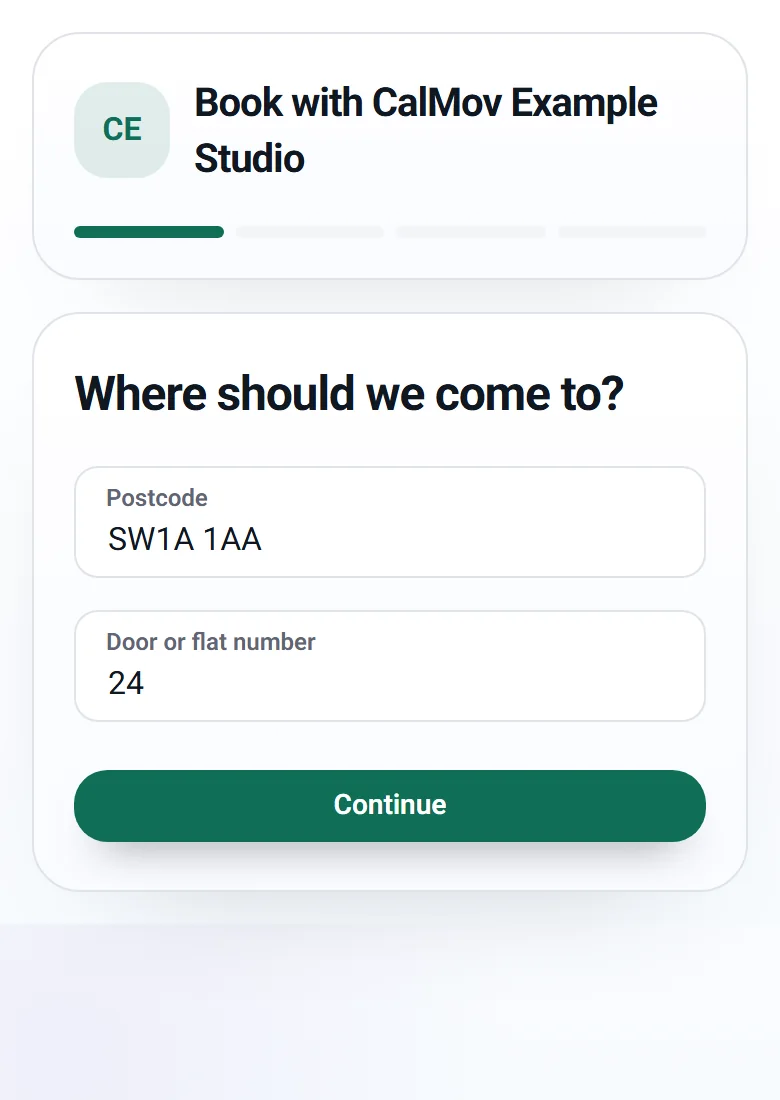
CalMov is online booking made for businesses that travel to clients. The client enters their address first and only sees times you can reach, allowing for the journey before and after each visit. Lite is free, with up to two active services and a fixed travel gap you set. Pro uses road-based drive times with expected traffic and can add travel charges by distance or drive time. It opens in the phone's browser, so clients and you have nothing to install.
Two tools fit stylists well. Time and price questions let the client's answer about hair length change the service: each answer adds minutes and price, so long hair might add 20 minutes and $20, and the client sees the total as they answer. Checks before booking is for services that need something first. If your state allows color off site, you can require an allergy alert test a set time before the appointment, such as 48 hours, and say how long a pass lasts. A client without an in-date pass cannot book the color service online and is offered your patch test service first. You record each result as Passed or Failed. It is a booking rule, not a replacement for the product directions or your professional judgment.
Rebooking reminders email a client a link when they are due again, based on the number of weeks you set for each service. On Pro, group bookings with a discount cover several people at one address, though a full wedding party is usually better scoped by you first.
Find your first 20 clients
Twenty regulars on a six-week cycle is three or four appointments a week before any new inquiry. Build that base close to home, then add event work on top.
- Tell past clients, friends and family what you offer and where. If you are leaving a salon, read your agreement first for terms about contacting its clients.
- Create a Google Business Profile as a service-area business with your ZIP codes, photos of your work (with permission) and your booking link. Ask for a review after every appointment.
- Post in neighborhood groups on Facebook and Nextdoor where the rules allow. Lead with who you help, such as new moms or seniors at home, and how to book.
- Call senior living and assisted living communities. Ask who arranges hair services, what license and insurance documents they need, and whether a weekly morning is open.
- Introduce yourself to wedding planners, venues, photographers and makeup artists. Bridal work is booked months ahead, so the sooner they know you the better.
- Offer on-site styling to offices and to hotels that host events and conferences.
- Book the next visit before you pack up, while the client is looking in the mirror.
- Thank clients who refer a neighbor. Two clients on one street is one drive.
Your first month: a week-by-week checklist
Get the board's answer, your permit and your insurance in hand before the first paid appointment. Then launch one model at a time. Rehearse event packages separately from regular house calls.
- Week 1: get your state board's answer in writing, apply for any permit, and ask your city and county about a business license.
- Week 1: register the business, sort out your EIN and bank account, and get liability and auto quotes that name every service.
- Week 2: write the menu your state allows off site, with prices by hair length, your ZIP codes and travel rules.
- Week 2: pack the kit, rehearse your longest service in a real room and time setup and cleanup. Set up your booking page and test it on a phone.
- Week 3: open booking in your core ZIP codes. Log time on site, products used and drive time for every visit.
- Week 3: contact two senior communities and two wedding vendors. Ask each client for a review.
- Week 4: compare planned and real times, fix services that ran over and adjust what you carry.
- Week 4: move tax money into its own account, note the next estimated tax date and schedule a monthly review of prices and area.
Frequently asked questions
Can a licensed cosmetologist do house calls in any state?
No. Each state board decides whether and how a licensee can work outside a salon. California, for example, requires a Personal Service Permit and limits which services it covers. Ask your own board in writing before you advertise home services.
Can I offer color services on house calls?
Only if your state allows it off site. California's Personal Service Permit list does not include dyeing, relaxing or chemically waving hair. Where color is allowed, follow the product directions, your insurer's terms and the FDA's advice to patch test before every application.
Do I need a special license for a mobile salon vehicle?
Often, yes. Texas licenses mobile establishments and Florida law sets rules for mobile cosmetology salons, including filing a monthly itinerary. Ask your state board what applies to a vehicle before you buy or convert one.
Do I need an LLC to be a mobile hair stylist?
No structure is mandatory. A sole proprietorship is the simplest and an LLC is the common alternative. The SBA explains how each affects taxes, paperwork and personal liability. An accountant can help you choose in one meeting.
How much does it cost to start a mobile hair stylist business?
House calls need a portable kit, permits, insurance and supplies. A mobile salon adds a vehicle and build-out. Sourced fees are modest: the SBA says business registration is usually under $300, California's permit application is $25 and Texas's mobile establishment application is $78. Get quotes for the rest.
Is a wedding party a normal online booking?
Usually not. It needs a plan: how many people, which styles, a trial, the venue, and a fixed ready-by time. Confirm the timeline before you take a deposit. One stylist works on one person at a time, so a large party may need a second licensed stylist.
How do self-employed stylists pay taxes?
The IRS says self-employed people generally pay estimated tax each quarter and file an annual return. Self-employment tax is 15.3% of net earnings, and filing is required at $400 or more of net self-employment earnings. Set money aside from every payment.
How do I keep drive time from wrecking my schedule?
Get the address before offering a time, stick to connected ZIP codes and group areas by day. Booking software that allows for the drive before and after each visit, such as CalMov, only shows clients times you can reach.
Sources and further reading
Sources used to check this guide. Check the linked guidance for current requirements, features and prices.
- California: Personal Service Permit information — California Board of Barbering and Cosmetology
- California: Personal Service Permit questions and answers — California Board of Barbering and Cosmetology
- Texas: mobile barbering and cosmetology establishment licenses — Texas Department of Licensing and Regulation
- Florida Statutes 477.025: cosmetology salons and mobile cosmetology salons — The Florida Senate
- Launch your business: registration, permits and insurance — U.S. Small Business Administration
- Apply for licenses and permits — U.S. Small Business Administration
- Get business insurance — U.S. Small Business Administration
- Self-employed individuals tax center — Internal Revenue Service
- Self-employment tax (Social Security and Medicare taxes) — Internal Revenue Service
- Get an employer identification number — Internal Revenue Service
- Standard mileage rates — Internal Revenue Service
- Hair dyes: safety, skin tests and following directions — U.S. Food and Drug Administration
- Hazard communication: labels, safety data sheets and training — Occupational Safety and Health Administration
How CalMov helps
CalMov combines service duration, working availability and customer location to help mobile businesses offer bookable times that allow for the surrounding journeys.
See CalMov for US mobile hair stylists