
UK guide
Postcode planning guide
How to group mobile appointments by postcode area
When customers book whichever day suits them, a mobile diary zigzags: one side of your area on Monday morning, the far side after lunch, back again on Tuesday. Grouping by postcode gives each part of your area its own days. This guide covers how postcodes work, finding clusters in past bookings, soft and hard area days, and an example week. Postcode facts were checked against Royal Mail, ONS and Ordnance Survey on 8 October 2026.
Quick answer
To group mobile appointments by postcode area, count your completed visits by postcode district over the last 12 weeks, join neighbouring districts with short drives between them into clusters, and give each cluster one or two regular days. Start with soft area days: tell customers which day you're usually nearby, but accept other days when the drive fits. Group, charge for or decline far, quiet districts. Grouping cuts cross-area driving, but it isn't route optimisation, so keep checking the journey before and after every booking.
What grouping by postcode does and doesn't do
Grouping is a planning decision: you choose which days you serve each part of your area, so visits in the same or neighbouring districts fall on the same day. Customers still pick their own times. What it removes is the long crossing that random booking creates.
It isn't route optimisation, which reorders a set of jobs into the shortest sequence. Grouping only decides which day an area gets, and CalMov doesn't optimise routes either.
It suits a solo operator with repeat customers who can be flexible about the day, such as groomers, cleaners, barbers and hairdressers. It suits urgent call-outs far less.
How UK postcodes are built, and which part to group by
A UK postcode has two halves. Royal Mail's guide to its address file says the outward code (PO1 in PO1 1AF) gets mail to the right local area, and the inward code (1AF) sorts it at the local delivery office. Read from the left, a postcode nests four levels: area (PO), district (PO1), sector (PO1 1) and unit (PO1 1AF).
The area is too big to plan a day around: the UK has only 124. The unit is too small: about 15 addresses on average, and never more than 100. The district, the whole outward code, is the useful level for most solo businesses. Use sectors when one district holds most of your work, or when a main road or river cuts it in two.
Two cautions. Postcodes were built for sorting mail, not for driving, and they follow addresses rather than distance, so a rural district usually covers far more ground than a city one. They also change as new addresses appear, the ONS notes, so recount every few months.
How to find your clusters in past bookings
Work from visits you actually did, not from a map. Twelve weeks smooths out an odd week and still shows who books now. You only need the district, so don't copy full addresses into a spreadsheet: the ICO's data minimisation principle is to hold only what the purpose needs.
- List completed visits from the last 12 weeks, from your diary or booking list.
- Write down only each visit's outward code: PO1 from PO1 1AF.
- Count visits per district and work out each district's share of the total.
- Add the typical drive from base to each district, at the time you usually travel.
- Join districts into a cluster when the drive between them is short, checked in a map app rather than by eye.
- Multiply each cluster's share by your working days: 28% of a five-day week is 1.4 days.
- Mark small, far districts as outliers to handle on their own.
The postcode cluster worksheet
Here is the worksheet filled in for the example business used later in this guide, with made-up districts and a base in XY1. Districts within 15 minutes of each other were joined. West (XY1, XY2) has 54% of visits, so it gets two days, and XY1 fills spare slots on the rest. East (XY4, XY5) has 28%: Wednesday and part of Friday. North (XY3) is 20 minutes or more from everywhere else, so it gets Tuesday. XY9 is the outlier.
The download has the same columns, two example rows and blank rows for your districts.
| Postcode district | Bookings in last 12 weeks | Share of bookings | Typical drive from base (min) | Proposed area day | Notes |
|---|---|---|---|---|---|
| XY1 | 58 | 34% | 8 | Any day | Base district: fills spare slots |
| XY2 | 35 | 20% | 15 | Monday and Thursday | West; one regular only does Tuesdays |
| XY3 | 22 | 13% | 20 | Tuesday | North: 20 min or more from the rest |
| XY4 | 26 | 15% | 22 | Wednesday | East, 12 min from XY5 |
| XY5 | 23 | 13% | 30 | Wednesday or Friday | East, on the way to XY9 |
| XY9 | 9 | 5% | 45 | Friday, after XY5 | Outlier, grouped with the east |
Soft and hard area days
A soft area day is a default: customers in that area hear which day you're usually nearby, but any time that fits stays bookable. A hard area day is a rule: the area is served on that day only. Start with soft days, so nobody is turned away.
CalMov has no setting that ties a postcode to a day, so soft days need nothing set up. For a hard day, set your service area to stop short of the outer district. Customers there can't book online, so ask them to message you, then add the visit from the calendar on that district's day. As the owner, you can tick Override when a booking falls outside your usual rules.
| Decision | Soft area day | Hard area day |
|---|---|---|
| What customers are told | The day you're usually nearby | The only day you visit them |
| Other days | Bookable when the drive fits | Not offered |
| Best for | Core districts and regulars | Outliers you would otherwise decline |
| Main risk | Some visits land off their area's day | Customers who can't do that day go elsewhere |
An example week before and after grouping
This is an illustrative example, not customer data. A solo operator does three visits a day, five days a week, from a base in XY1, using the worksheet above. The districts and drive times are made up, and both weeks have the same 15 visits. Only driving minutes are counted: parking, access, setup and pack-down don't change, so they're left out.
Before, customers booked any day. The week shown is a random spread of the 15 visits whose total sits at the median of 100,000 such spreads, so it's typical, not a bad week. After, the area days apply and the XY2 regular keeps Tuesday. A cross-area journey goes from one cluster to another, including the drives from and back to base.
Driving falls from 427 to 337 minutes, an hour and a half less, and cross-area journeys from 11 to 7. Wednesday and Friday get longer, because the long drives east now happen on the days set aside for them. Order also matters less: the grouped week in its worst order still beats the scattered week in its best.
| Day or measure | Before grouping | After grouping |
|---|---|---|
| Monday | XY1, XY9, XY1: 106 min | XY1, XY2, XY1: 46 min |
| Tuesday | XY1, XY2, XY4: 80 min | XY3, XY3, XY2: 68 min |
| Wednesday | XY2, XY1, XY3: 70 min | XY4, XY4, XY5: 72 min |
| Thursday | XY5, XY5, XY1: 76 min | XY2, XY1, XY1: 46 min |
| Friday | XY2, XY4, XY3: 95 min | XY1, XY5, XY9: 105 min |
| Week's driving | 427 min (7 h 7 min) | 337 min (5 h 37 min) |
| Journeys | 20, of which 11 cross areas | 20, of which 7 cross areas |
| Driving for the XY9 visit | 90 min | 67 min |
| Every day in its best order | 411 min | 333 min |
| Every day in its worst order | 478 min | 404 min |
What to do with outlying postcodes
An outlier is a district that's far from base and books rarely, like XY9. You can group it, charge for it or decline it. Grouping costs nothing to offer, so try it first: in the example week, the single XY9 visit took 90 minutes of driving between two base-district visits, and 67 when it followed the east side.
A charge covers money, not time. On Pro, Travel pricing adds a charge by distance or drive time for the one-way journey from your base. Declining is fair when demand doesn't repeat. The service area guide and calculator work through the full cost of an outer job.
How to tell customers about area days
Put one plain line wherever customers meet your booking link: your website next to the booking button, your social profiles and your replies to enquiries. Name the districts as well as the day, so people can check their own postcode.
Tell regulars before anything changes, keep the day of anyone who can't move, and don't promise an arrival window you can't keep. For example:
- Soft: ‘I'm in XY3 on Tuesdays, so a Tuesday is best if you can. Other days are fine when you see a time.’
- Hard: ‘I visit XY9 on Fridays. Message me and I'll book you in.’
- Regulars: ‘Your usual day stays the same unless you'd like to change it.’
Why drive times still vary inside a cluster
A cluster cuts the long crossings; it doesn't make every hop short. Two addresses in one district can be further apart by road than two either side of a district boundary, and the same hop can take longer at school-run times.
Mapped driving is also only part of the gap. Parking, walking to the door, access, setup and pack-down sit on top, and they differ by street: a permit-parking terrace or a block of flats can take longer than the drive. Keep those allowances separate from the drive, keep checking the journey on both sides of each booking, and measure gaps by cause before tightening anything.
When grouping by postcode doesn't fit
Grouping trades a little choice for less driving. That trade doesn't suit everyone.
- Urgent or same-day work, such as fitting a tyre after a puncture: customers can't wait for an area day.
- Very rural areas, where one district can cover several villages: group by town or along a main road instead.
- Customers who need a fixed weekday, such as shift workers: keep their day and build around it.
- Mostly one-off visits from new customers: there's little repeat demand to steer, and too few visits to show a pattern.
- A diary that's already compact: if most drives are short, area days add rules without saving much.
How CalMov fits with area days
CalMov doesn't plan your week, reorder visits or optimise routes. Area days are your plan; CalMov makes sure each booking can be reached. Customers enter their address first and are only offered times you can reach, allowing for the journey before and after each visit.
Your service area, by distance or drive time, is set in Hours & availability › Travel. On Lite, CalMov leaves the fixed gap you set between bookings, whether the next visit is next door or across town, so grouping is what keeps real drives inside it. On Pro, road-based drive times with expected traffic decide whether a cross-area visit fits, and Eco times marks the times that need the least extra driving.
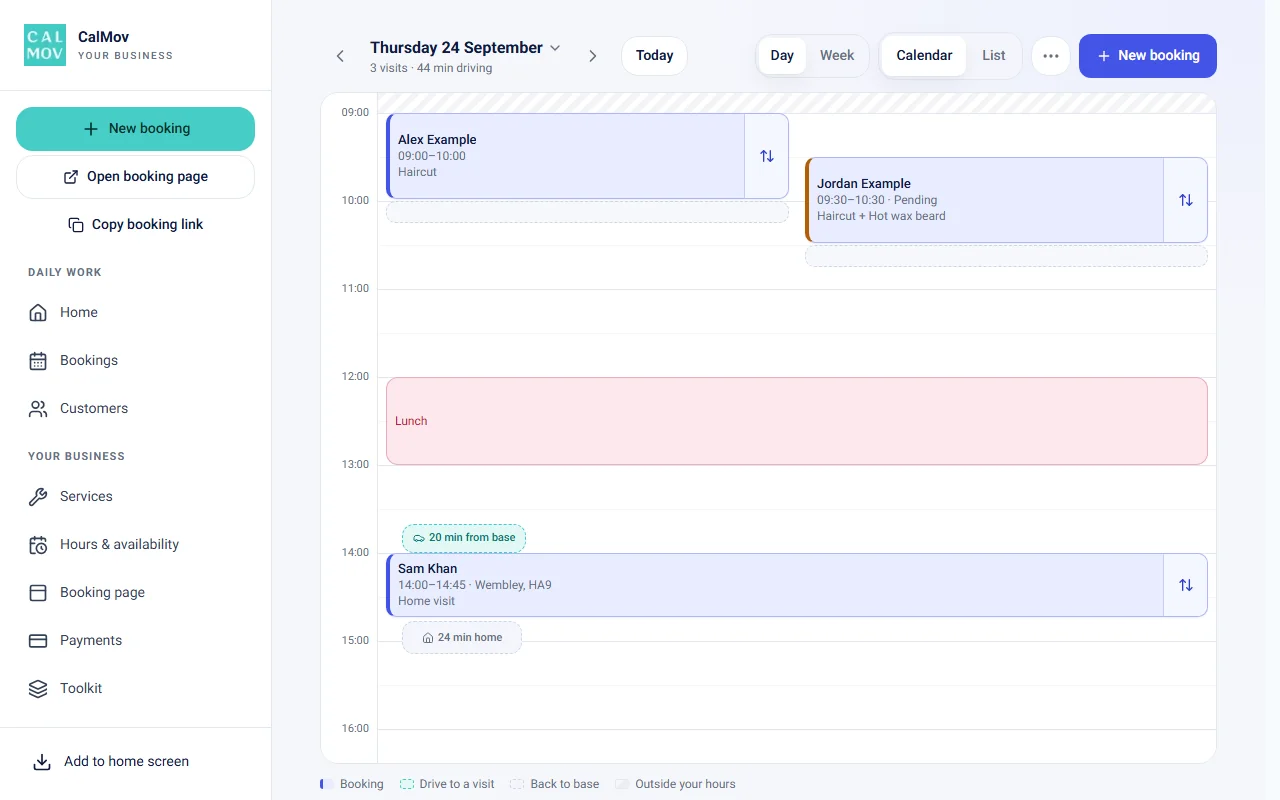
The calendar shows the drive time between visits and Back to base, so you can see whether a week is really grouped.
Frequently asked questions
Should I group by postcode district or sector?
Start with the district, such as PO1. Use sectors, such as PO1 1, when one district holds most of your work or a main road or river cuts it in two. A full postcode is too small to plan around.
How do I start area days without losing regulars?
Make them soft. Tell regulars first, keep the day of anyone who can't move, and keep other days bookable when the drive fits. If several regulars in one district need the same other day, move that district's day.
Does CalMov set area days or plan my route?
No. There's no setting that ties a postcode to a day, and CalMov doesn't reorder your day or optimise routes. It only offers times you can reach, allowing for the journey before and after each visit.
How many weeks of bookings do I need?
Twelve weeks of completed visits is a practical start. Use longer if you do only a few visits a week, or compare the same season if your work is seasonal. Recount every quarter.
Do postcode districts match drive times?
No. Royal Mail built postcodes for sorting mail, so district boundaries say nothing about roads. Check drive times between districts at the times you usually travel before you join them into a cluster.
How many clusters should I have?
No more than you have working days, sized by share: a cluster with 20% of your visits fills about one day of a five-day week. Fewer, bigger clusters are easier to explain. Leave small, far districts as outliers.
Sources and further reading
Sources used to check this guide. Check the linked guidance for current requirements, features and prices.
How CalMov helps
CalMov combines service duration, working availability and customer location to help mobile businesses offer bookable times that allow for the surrounding journeys.
See how CalMov checks the drive before and after each booking