UK guide
Service area guide
What to do when a customer outside your area wants to book
Sooner or later someone just outside your area asks for a visit. Saying yes every time fills your week with long drives, and saying no every time turns away work that might have paid. This guide sets out four ways to answer, works through what one far job really earns, and gives wording for each answer. It's written for solo mobile businesses in the UK, and the figures are an illustrative example.
Quick answer
Decide before the request arrives. You can decline politely, accept with a travel charge, offer a day you're already nearby, or decide each request yourself. A far job costs more than its drive: in the example below, a £45 visit 35 minutes away earns £12.65 for each hour of your time, against £30.45 for a visit nearby. Pairing it with a second visit on the same trip and adding a £15 travel charge brings it back to £30.23. So group first, charge where you can, and decline one-offs that would take a slot you'd fill nearby.
Why a far job costs more than its drive
The drive is the part you see. The bigger cost is what the time pushes out: an extra hour on the road is an hour you can't sell nearby, and it pushes the next customer later, so one far booking can tighten the rest of the day.
Miles alone don't tell you much. A customer 10 miles away on a fast road can be quicker to reach than one 4 miles away across town, so think in minutes where you can.
What one far job earns: an example
This is an illustrative example, not customer data. A solo mobile massage therapist charges £45 for a 60-minute visit. A nearby customer is 4 miles and 10 minutes from base. A far customer is 16 miles and 35 minutes away. The car costs 55p a mile, HMRC's 2026–27 flat rate for the self-employed. Parking, setup and pack-down are the same for both, so they're left out.
Paired means two far visits 3 miles and 10 minutes apart share one trip: 35 miles and 80 minutes of driving for both, so half each.
| Visit | Service and driving time | Vehicle cost | Earned after vehicle | Per hour of your time |
|---|---|---|---|---|
| Nearby, £45 (8 miles, 20 min there and back) | 80 min | £4.40 | £40.60 | £30.45 |
| Far, on its own, £45 (32 miles, 70 min) | 130 min | £17.60 | £27.40 | £12.65 |
| Far, on its own, with a £15 travel charge | 130 min | £17.60 | £42.40 | £19.57 |
| Far, paired with a second far visit, £45 | 100 min | £9.63 | £35.38 | £21.23 |
| Far, paired, with a £15 travel charge | 100 min | £9.63 | £50.38 | £30.23 |
What the example tells you
On its own, the far visit earns less than half the nearby rate for each hour, and a £15 charge only closes part of the gap, because the problem is time as well as money. Sharing the trip with a second visit does about as much as the charge. Doing both brings the far visit level with nearby work.
Change the numbers to your own. If your week has spare time, the far visit's hours cost you less. If your nearby days are full, a far visit can cost you a nearby customer as well.
Four ways to answer
Pick a default for each part of your area before customers ask, so you answer the same way every time.
| Answer | When it fits | What it costs you | In CalMov |
|---|---|---|---|
| Decline | One-off requests far from any of your regular work | The customer | Set a maximum distance (Plus): the customer is turned away at the address step |
| Charge for travel | Requests a little past your free area | Time: a charge covers money, not hours | Travel pricing by distance or drive time (Plus) |
| Group | Areas with repeat demand, or near a regular | A little flexibility from the customer | Show the days you're nearby and Eco times (Plus) |
| Decide case by case | Unusual jobs, or customers you want to keep | Your time answering | A contact link on the outside-area message (Plus), then add the booking yourself |
Questions to ask about each request
Work down the list. The first clear answer usually decides it.
- Will it repeat? A regular every four weeks is worth more planning than a one-off.
- Are you already nearby on some day? Offer that day first: it costs the customer nothing.
- Will a travel charge cover the trip there and back, at your hourly figure?
- Would it take a slot you'd otherwise fill nearby? If your nearby days are full, the far visit costs you a nearby customer.
- If it won't repeat, you're never nearby and it would push out nearby work, decline, and suggest someone local if you know one.
What to say to the customer
Answer quickly and be specific. A clear no today is kinder than a maybe that waits a week. For example:
- Declining: ‘Thanks for asking. You're just outside the area I cover, so I can't book you in. Someone local will be able to come sooner.’
- Charging: ‘I can come to you. Because you're a little further out, there's a £15 travel charge, and you'll see it before you confirm.’
- Grouping: ‘I'm in your area on Thursdays. Would a Thursday suit you?’
- Case by case: ‘Let me check my week, and I'll come back to you today with a time that works.’
Setting your boundary in CalMov
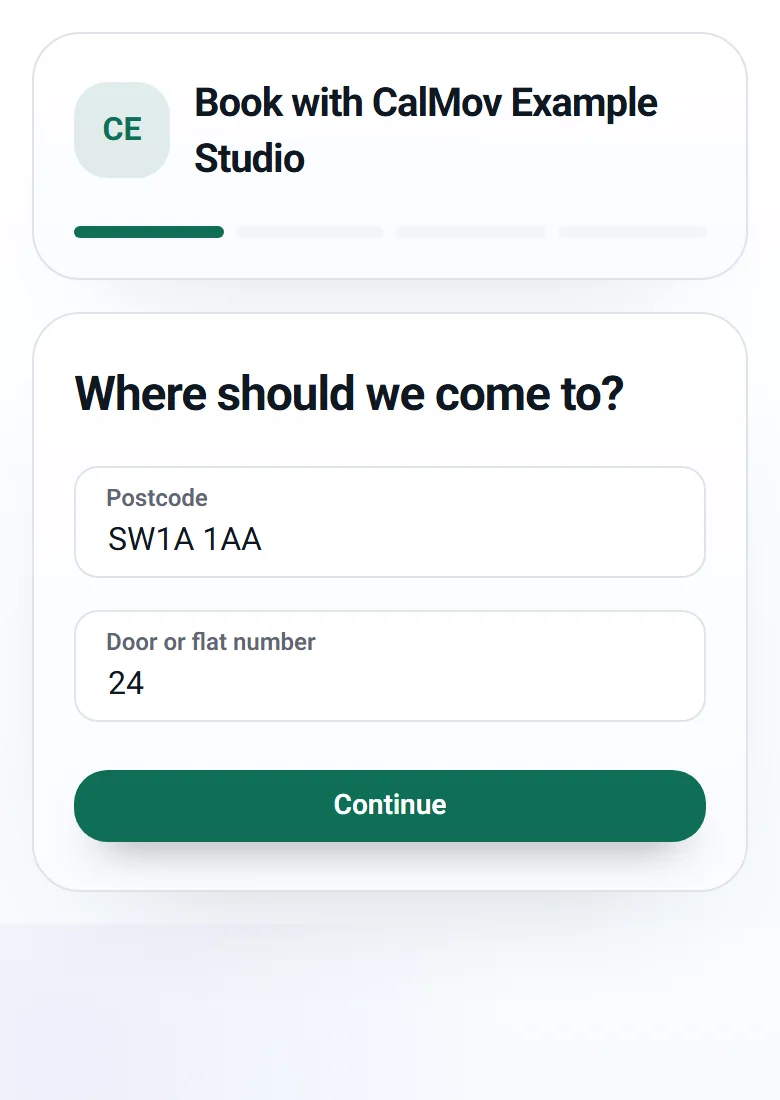
On Plus, set a Maximum distance (miles) in Hours & availability › Travel. It's measured in a straight line from your base, so an address across a river can be inside it but a long drive away. Customers outside it are turned away at the address step. If you also charge for travel with Show travel charges before checkout ticked, they're told as soon as they enter their postcode, and a Contact for customers outside your area puts your email or phone in that message, so the request reaches you instead of going elsewhere.
A Maximum travel time (min) applies to every journey, including from your base and back to it. A customer further than that from your base is only offered a time between two visits near them, which groups far work without any extra rules.
When you agree a visit yourself, add it from the calendar. As the owner, you can tick Override to book an address outside your service area, and you see what's being overridden before it's saved. On Lite, CalMov doesn't place addresses, so it can't apply a maximum distance or travel time: say which areas you cover wherever you share your booking link.
When to change your answer
Keep a simple tally of requests from outside your area by postcode district: asked, booked and declined. When one district keeps asking, it has earned a regular day. When a district never books after hearing the charge, either the charge is doing its job or the area isn't worth serving.
Frequently asked questions
Is it rude to turn down customers outside my area?
No, if you say so quickly and clearly. Most people would rather hear no today than wait for a maybe. Suggesting someone local helps if you know one.
Should I charge more or just say no?
Charge when the extra time fits your week. Decline when it would push out nearby work, because a travel charge covers the money, not the hour on the road.
Can customers outside my area still contact me through CalMov?
Yes, on Plus, when you charge for travel and show the charge before checkout. Add a Contact for customers outside your area, and the message they see on the postcode step links to your email or phone.
Can I still book someone outside my area myself?
Yes. Add the booking from the calendar and, as the owner, tick Override. You see what's being overridden before it's saved.
Does CalMov measure the maximum distance by road?
No, in a straight line from your base. Travel charges by distance use the road distance. Set a maximum travel time as well if rivers or road layout make some nearby addresses slow to reach.
Sources and further reading
Sources used to check this guide. Check the linked guidance for current requirements, features and prices.
How CalMov helps
CalMov combines service duration, working availability and customer location to help mobile businesses offer bookable times that allow for the surrounding journeys.
See how CalMov handles your service area