
UK guide
Travel pricing guide
How much should a mobile business charge for travel?
Every mobile business pays for the drive somehow: in its prices, in a travel charge or out of its own pocket. This guide works out what a trip really costs, compares charging per mile, per minute and by zone, and covers how to show the charge so nobody is surprised. HMRC and CMA guidance was checked on 4 November 2026. It's written for UK sole traders and small teams, and it isn't tax or legal advice.
Quick answer
Charge for the extra driving beyond a free area around your base, not for every trip. Work out what each extra mile costs you there and back, in running the vehicle and in your time, then set two or three brackets. With the vehicle at 55p a mile (HMRC's 2026–27 flat rate for the self-employed), your time at £30 an hour and roads averaging 24 mph, each extra mile from your base costs about £3.60. Charge by distance if traffic is steady and by drive time if it isn't, and tell customers how the charge works before they book.
Should you charge for travel at all?
You don't have to. Building the drive into your prices is simplest when most customers live a similar distance away: the price is the price. A separate charge earns its place when your area is big enough that the furthest customers cost far more to reach than the nearest. Without one, nearby customers pay for distant ones, or distant work quietly loses money.
The usual pattern is a free area around your base, with its travel built into your prices, and brackets beyond it. A charge also works as a filter. Some outer customers book anyway, which pays for the drive, and some don't, which keeps your days compact. Both outcomes are fine.
What a trip actually costs
Two things: running the vehicle, and your time behind the wheel. Fuel is the smaller part of the first. HMRC's advisory fuel rates for company cars, worked out from fuel prices, put a 1.4 to 2 litre petrol car at 17p a mile from 1 September 2026. The flat rate self-employed people can claim instead of their real running costs, such as insurance, repairs, servicing and fuel, is 55p a mile for the first 10,000 business miles in 2026–27 and 25p after that. Neither is a price, but the 55p is a fair benchmark if you don't track your own costs.
Your time usually costs more. Driving minutes are minutes you can't sell. If you'd otherwise fill them with work, value them at what you earn an hour. If the day has spare time anyway, value them lower. And count the drive home: a charge quoted one way still has to pay for the return.
- Cost of each extra mile from your base = 2 × vehicle cost a mile + 2 × minutes a mile × your rate a minute.
- At 55p a mile, 2.5 minutes a mile (24 mph) and £30 an hour: £1.10 + £2.50 = £3.60.
Working out your brackets: an example
This is an illustrative example, not market prices. A solo mobile hairdresser builds travel into their prices up to 5 miles from base. Beyond that, the car costs 55p a mile, their time is worth £30 an hour and the roads average 24 mph, so each extra mile from base costs £3.60 there and back. Parking, setup and pack-down are left out because they don't change with distance.
| Distance from base (one way) | Extra driving there and back, at most | Full cost at the bracket's middle | Full cost at the bracket's edge |
|---|---|---|---|
| Up to 5 miles | None | £0 (in your prices) | £0 |
| 5 to 10 miles | 10 miles, 25 minutes | £9 | £18 |
| 10 to 15 miles | 20 miles, 50 minutes | £27 | £36 |
| 15 to 20 miles | 30 miles, 75 minutes | £45 | £54 |
What the example tells you
The full cost climbs quickly, and few customers will pay £27 to have a haircut at home. That's the useful finding. Set the first bracket close to cost, around £10 here, and treat anything past 10 miles as a decision rather than a price: put it on a day you're nearby, charge more, or decline.
Rounding to whole pounds keeps the brackets easy to read. Rounding down is generous; rounding up covers the customers at the far edge of each bracket.
Per mile, per minute or by zone?
All three charge more for further away. They differ in what they measure, how easy they are to explain and whether the charge changes with the time of day.
| Decision | Per mile | Per minute of driving | By postcode zone |
|---|---|---|---|
| Easy to explain | Yes: ‘up to 10 miles, £10’ | Less so: customers can't see their drive time | Yes: ‘TW9 and TW10, £10’ |
| Follows what the trip costs you | When traffic is steady | Yes, including rush hour | Roughly, if the zones match drive times |
| Same charge at every time of day | Yes | No: a 17:00 visit can cost more | Yes |
| Suits | Towns and rural areas | Cities and congested routes | Areas customers know by postcode |
| In CalMov | Distance brackets, by road (Plus) | Drive time brackets, with expected traffic (Plus) | Not built in: set distance brackets that match your zones |
One customer, three ways to charge
A customer lives 8 miles from base. The drive takes 18 minutes at 10:00 and 30 minutes at 17:00. Here is what each method charges, using brackets of 5 to 10 miles for £10, 15 to 25 minutes for £10 and 25 to 40 minutes for £20, and a £10 zone for their postcode district.
| Method | 10:00 visit (18 min each way) | 17:00 visit (30 min each way) |
|---|---|---|
| Per mile | £10 | £10 |
| Per minute of driving | £10 | £20 |
| By postcode zone | £10 | £10 |
| Your driving there and back | 36 minutes | 60 minutes |
Why the time of day matters
The 17:00 visit takes 24 more minutes of your day, worth £12 at £30 an hour, and only the per-minute charge notices. If your evenings are busy and your roads jam, that's an argument for charging by drive time. If customers mostly book quiet daytime slots, distance is simpler and nearly as accurate.
A charge that changes with the time is fair as long as customers can see it before they choose. It also nudges people towards the times that are easier to reach.
One way or there and back?
Most travel charges are quoted from your base to the customer, because that's the distance a customer can picture. Your cost is the round trip, so price each one-way bracket to cover the drive back too, as the example does.
CalMov measures the one-way journey from your base: road distance for distance brackets, or drive time with expected traffic at the time of the visit. It doesn't measure from your previous job, so a customer's charge doesn't depend on what else is in your day.
How to show the charge to customers
Since April 2025, the Digital Markets, Competition and Consumers Act has required the price you give customers to be the total price, including charges they can't avoid. The CMA's guidance uses delivery charges that vary with the customer's location as an example: if you don't know the charge yet, give enough information for the customer to work out the total, as prominently as the main price, and include the charge in the total as soon as you can work it out.
For a mobile business, that points to three habits. This is a summary, not legal advice, and the CMA's guidance is linked below.
- Show your brackets next to your prices, not in small print.
- Tell customers their charge as soon as they give their address.
- Include it in the total before they confirm.
- A call-out fee everyone pays isn't a travel charge: it's part of your price, so include it in the prices you advertise.
Do you charge VAT on a travel charge?
If you're VAT registered, normally yes. HMRC's VAT guide says costs you incur in making your own supply, such as travelling expenses, must be included in the value of that supply when VAT is worked out, even when they're shown separately on the invoice. They aren't disbursements. So the travel charge is taxed in the same way as the service it goes with. If you're not registered, there's no VAT to add.
Pricing and tax are separate decisions. Claiming 55p a mile in your accounts doesn't mean you must charge it, and charging for travel doesn't change what you can claim. Ask an accountant if you're unsure.
Setting up travel charges in CalMov
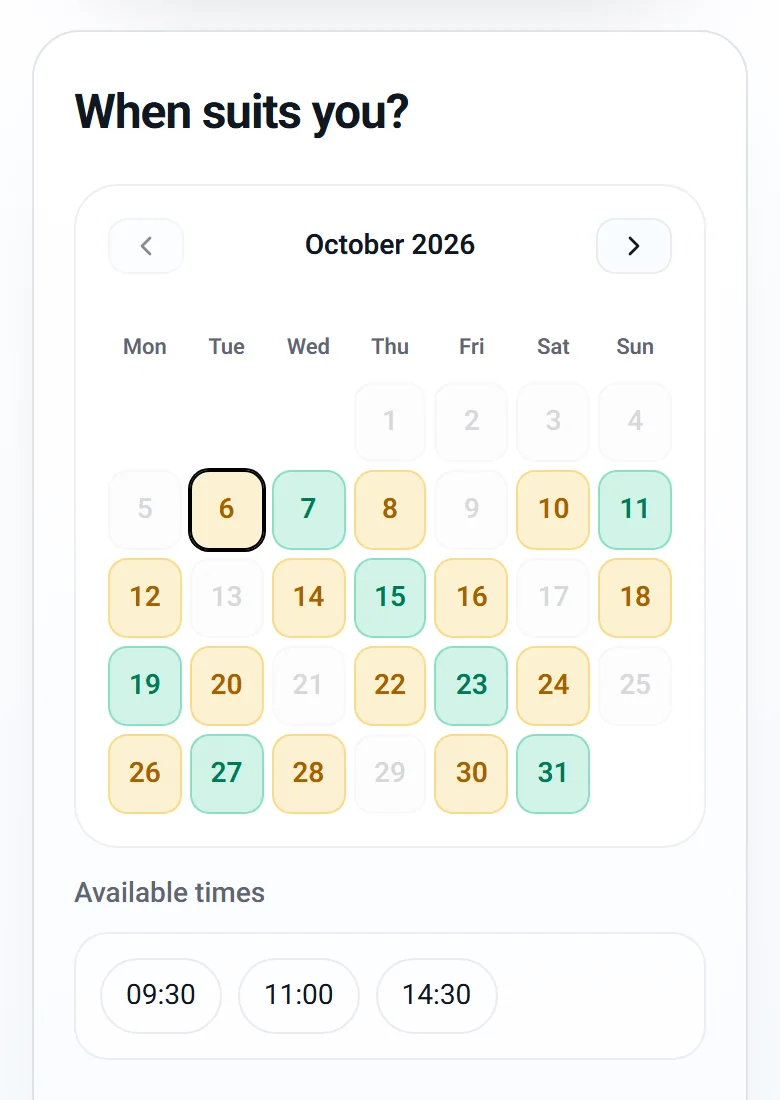
Travel pricing is on Plus. In Hours & availability › Travel, tick Apply a travel surcharge, choose Distance (in miles) or Drive time (in minutes) and add a bracket for each band, with nothing for your nearest customers. Tick Show travel charges before checkout, and customers see the charge for their postcode as soon as they enter it, each time's charge on the time, and the charge as its own line before they confirm.
CalMov doesn't price by postcode zone. If you think in zones, set distance brackets that roughly match them and try a postcode from each. On Lite there are no travel charges: CalMov keeps the fixed gap you set between bookings, so build travel into your prices.
Frequently asked questions
How much should I charge per mile for travel?
There's no standard rate. Work it out from your costs: the vehicle (HMRC's flat rate for the self-employed is 55p a mile for the first 10,000 miles in 2026–27) and your time, for the drive there and back. With £30 an hour and 24 mph roads, that's about £3.60 for each extra mile from your base.
Should the first few miles be free?
Usually. Most customers live near your base, and a free area keeps your prices simple. Build the travel for that area into your prices and charge only beyond it.
Is a travel charge that changes with the time of day fair?
Yes, if customers can see it before they choose. A 17:00 visit through traffic takes more of your day. With drive time brackets on Plus, CalMov shows each time's charge on the time.
Do I have to show the travel charge before someone books?
The CMA's guidance says the price should include charges customers can't avoid. Where it depends on the address, tell customers how it's worked out as clearly as the main price, then include it in the total once you know it.
Do I charge VAT on travel?
If you're VAT registered, normally yes. HMRC treats travel costs you incur in doing the job as part of your service, not as a disbursement, so VAT applies to the charge as it does to the service.
Can CalMov charge travel by postcode?
No. Travel pricing on Plus uses distance brackets in miles or drive time brackets in minutes, measured one way from your base. Set distance brackets that roughly match your postcode zones.
Sources and further reading
Sources used to check this guide. Check the linked guidance for current requirements, features and prices.
- Simplified expenses if you're self-employed: vehicles — GOV.UK
- Advisory fuel rates — HM Revenue & Customs
- Providing clear and accurate information about prices: summary — Competition and Markets Authority
- Price transparency (CMA209) — Competition and Markets Authority
- VAT guide (VAT Notice 700), section 25: disbursements — HM Revenue & Customs
How CalMov helps
CalMov combines service duration, working availability and customer location to help mobile businesses offer bookable times that allow for the surrounding journeys.
See how CalMov shows travel charges before customers book